
Spotlight on: network congestion
Congestion in the electricity grid is highly problematic for our customers and society. It slows investment, makes it difficult or impossible for companies to expand or become more sustainable and can even lead to companies leaving the Netherlands. Economic development slows and sustainability measures are delayed as a result. Housing construction projects and households are also affected. An upgrade to install a charging station might no longer be possible all of a sudden. So congestion causes economic damage to society as a whole. According to research by Ecorys, grid congestion (the overcrowded power grid) in the Netherlands costs society between €10 and €40 billion annually. If the pressure on the grid continues to increase in the coming years, these effects could become even more pronounced. That is why it is crucial for us to find solutions for customers as quickly as possible and utilise the grid as efficiently as possible.
In 2025, the queues and waiting times for new connections unfortunately increased further, both for businesses and households. In many areas, customer demand is growing faster than the pace of network expansion. Other solutions, such as greater flexibility and congestion management, are not yet sufficiently effective.
Capacity shortages on the grid when feeding in and using electricity
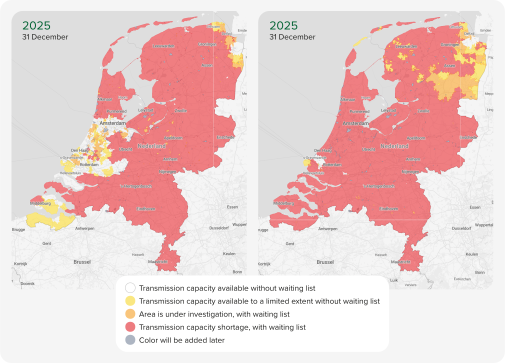
The figure above shows the congestion situation on 31 December 2025 for the regional network operators and TenneT combined. At the end of 2025, there were 7,044 transmission restrictions affecting our customers (2024: 6,862). That is less than the permitted maximum of 8,535.
Working on solutions that can be implemented in the short term
We are working independently and in collaboration with the government, customers and market parties to develop solutions that can be implemented in the short term. In terms of grid congestion, the Flevopolder-Gelderland-Utrecht (FGU) region faces greater challenges than anywhere else in the Netherlands. The pressure on the national transmission network is considerable here and coincides with issues in the regional networks. In the FGU Network Congestion Action Plan, we collaborate intensively and at governmental decision-making level with the affected provinces, national government, TenneT and Stedin in order to implement a broad package of measures. This encompasses aspects such as congestion management, higher taxation, controllable generation, grid-friendly new construction, grid-friendly charging, and grid-friendly storage.
The additional measures we are implementing include more accurate customer forecasts and improved capacity planning procedures. Where possible, we are accelerating the key expansion projects and putting tenders out to the market in order to temporarily obtain a large amount of additional market-driven and dynamically manageable capacity. We can use that capacity together with TenneT for congestion management. In all regions, we are strengthening broad regional collaboration through energy boards and other relevant public-private consultation structures. This involves bringing together authorities, network companies, market parties and knowledge institutions to drive infrastructure development in an integrated manner, ensure adequate space for infrastructure and achieve coherence in spatial and energy system choices. We share data and insights, develop joint scenarios, coordinate implementation programmes and take action to prevent potential delays in implementation. We are also working on technical rules for the energy market (‘code decisions’ taken by the ACM), new contract forms and products, such as the group transmission agreement for energy hubs.
One key solution for dealing with scarcity is social prioritisation.
One key solution for dealing with scarcity is social prioritisation. The fact that the ACM adjusted frameworks in 2025 in order to give priority to customers with socially important functions when allocating transmission capacity is a positive development. Those functions include security (such as the fire service, police, hospitals) and basic needs of society (such as drinking water, education and housing). These frameworks are important, but we realise that they are not a structural solution to the problem and leave some of our customers out in the cold.
Working on solutions that lead to structural improvement
The future energy system requires major investments in grid expansion and upgrades, grid digitalisation and improvement of IT systems for flexible solutions and safety. These are substantial investments that take time to implement, and for which the costs precede the benefits. Given that there are also structural constraints, additional choices must be made regarding how we use energy. Flexibilisation of part of the demand for energy is in any case necessary in the transition to sustainable energy: it delivers financial benefits for the end user, promotes good utilisation of sustainable energy and results in a structurally lower requirement for infrastructure.
Grid control is crucial in order to make effective use of this flexibility. Capacity management allows us to control the grid much more effectively, ultimately on a second-by-second basis. This means that we would no longer need to predict what we expect our customers to do. We would then be able to allow higher loads and intervene in real time if we see that the permissible load limit is being used in systems. This contributes directly to reducing the congestion costs and also opens up opportunities for accommodating more customers.