


Why this topic is important
We are dealing with an unprecedented infrastructure challenge. However, physical realisation of our work is constantly hampered by task feasibility limits. This is a general trend that we also see in other social construction projects in the Netherlands (road construction, hydraulic engineering, housing construction). The investments in our network increased again relative to 2024. At the same time, customer demand for connections and capacity on the power grid remains high. Congestion on the high-voltage, medium-voltage and low-voltage grid is growing.
As a network operator, we are preparing not only our gas and electricity networks for a sustainable future, but also our market facilitating systems and services. We are working towards a new situation of more awareness and choices in energy generation and consumption, and a future-proof energy system which is reliable, accessible and affordable.
Our performance
|
Making the energy supply and our organisation sustainable |
|||
|
KPI |
Target for 2025 |
Performance in 2025 |
Target for 2026 |
|
Carbon emissions from own operations |
171 kt. This includes procurement of renewable energy representing 271 kt (total: maximum of 442 kt) |
176 kt. This includes procurement of renewable energy representing 263 kt (total: 439 kt) |
118 kt. This includes procurement of renewable energy representing 302 kt (total: maximum of 420 kt) |
|
Circular procurement |
At least 9% |
7.5% |
At least 14% |
|
Gross investments |
At least €2,116 million |
€2,115 million |
At least €2,210 million |
For a detailed report on our performance, please refer to the Objectives and performance section.
More sustainable energy supply
The energy transition is a complex system change. To be able to have a sustainable energy system in place by 2050, we need to do more than simply replace fossil fuels with renewable energy generation. Our definition of solutions goes further than creating new connections or implementing upgrades. It also includes solutions to ensure that we as a society need less energy (for example, by insulating buildings) or to achieve a better spread of the demand for energy throughout the day.
In recent years, we already addressed the obvious aspects of our energy usage as a component in the energy transition. This year and in the coming years, investments must continue to rise to achieve a profound system change: in how we produce energy, how we use our grids and how energy users will participate much more actively in the system. We are working on an update to our Energy Vision document. In it, we examine bottlenecks in the transition investments in the market and among customers.
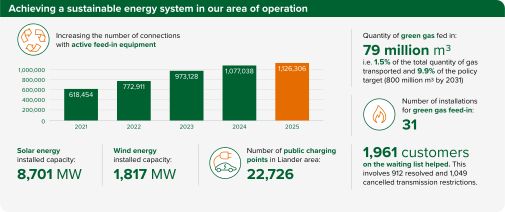
Number of connections with active feed-in equipment
Each year we connect more wind turbines and solar farms to the power grid. In addition, green gas producers are also increasingly turning to us for connections so that they can feed their sustainable gas into the natural gas network. In 2025, we saw another increase in the number of consumer-registered connections with an active feed-in installation in our service area, from more than 1 million to roughly 1,126,000 (up +5%). The rate of growth is levelling off for the second year running. Congestion is a major cause of this.
Decarbonisation of industry
On behalf of the steering group for the National Industry Decarbonisation Programme (Nationaal Programma Verduurzaming Industrie or NPVI), we are working on the Flywheel (Vliegwiel) project. This is a collaboration between the Dutch Ministry of Climate Policy and Green Growth, network operators and industry clusters to accelerate decarbonisation of industry. The Safe Haven pilot is part of the programme. A Safe Haven is a strategically designed area for the industry and economy of the future, where there is sufficient space and energy infrastructure. The area targets safety and future-proofing, making optimal use of the available energy sources such as electricity, heat and sustainable gas. The safe haven is a specific example of how you can build and plan based on the system of the future rather than in a demand-driven manner, and as such it is a concrete form of energy-focused urban planning.
We are also working with our largest industrial customers to develop an approach for setting up transition pathways. The aim is to provide clarity for customers and Liander as quickly as possible. Together, we will use workshops to explore the alternatives there are to natural gas, to detail the desired final solution, and to see when it could be available and what can be done in the meantime by using scope for flex products and new contract forms.
Making the built environment more sustainable by deploying gas generators
The use of electric heat pumps in the built environment is a popular sustainability strategy. The large-scale deployment of electric heat pumps can be a major problem on the coldest days of the year due to the high simultaneous power demand of these systems. This means that the low-voltage, medium-voltage and high-voltage grids will need to be upgraded in many places. The use of a gas generator at medium-voltage level can help mitigate this problem, reducing the need for upgrades to medium-voltage and high voltage grids. Investing in smart, controllable heat pumps and other large electrical appliances in households, as well as the use of hybrid heat pumps, can also help to reduce simultaneous power demand and avoid the need for grid expansion at all levels. The use of gas generators as a back-up at medium-voltage level and hybrid heat pumps in individual homes lets customers make improvements in sustainability and drastically reduces the use of natural gas and the level of carbon emissions compared to conventional central heating systems.
Mobility
In 2025, more than 400,000 new passenger cars will have been registered in the Netherlands, of which more than one in three will be fully electric. Despite further phasing out of government incentives, we expect demand for electric cars and charging facilities to continue to grow. In order to facilitate this growth responsibly, the principle of ‘grid-friendly’ smart charging should be made mandatory for all public and private charging points. That ensures an optimal match between electric vehicle charging and the available capacity of the electricity grid, thereby preventing peak loads.
Grid-friendly charging as the new norm
Customers with electric cars are prepared to charge their cars at home at different times if this does not cause them any inconvenience and if they receive compensation for doing so. This is the outcome of a pilot project we conducted together with network operator Enexis, in collaboration with charging facility providers ANWB Energie, Eneco eMobility and Vattenfall. In total, this form of management was applied to the charging sessions of 330 customers. These customers had both fixed and dynamic energy contracts. The load profile that was used led to a reduction in electricity demand of up to 68% during the evening peak for customers with fixed energy contracts and up to 55% for customers with dynamic energy contracts.
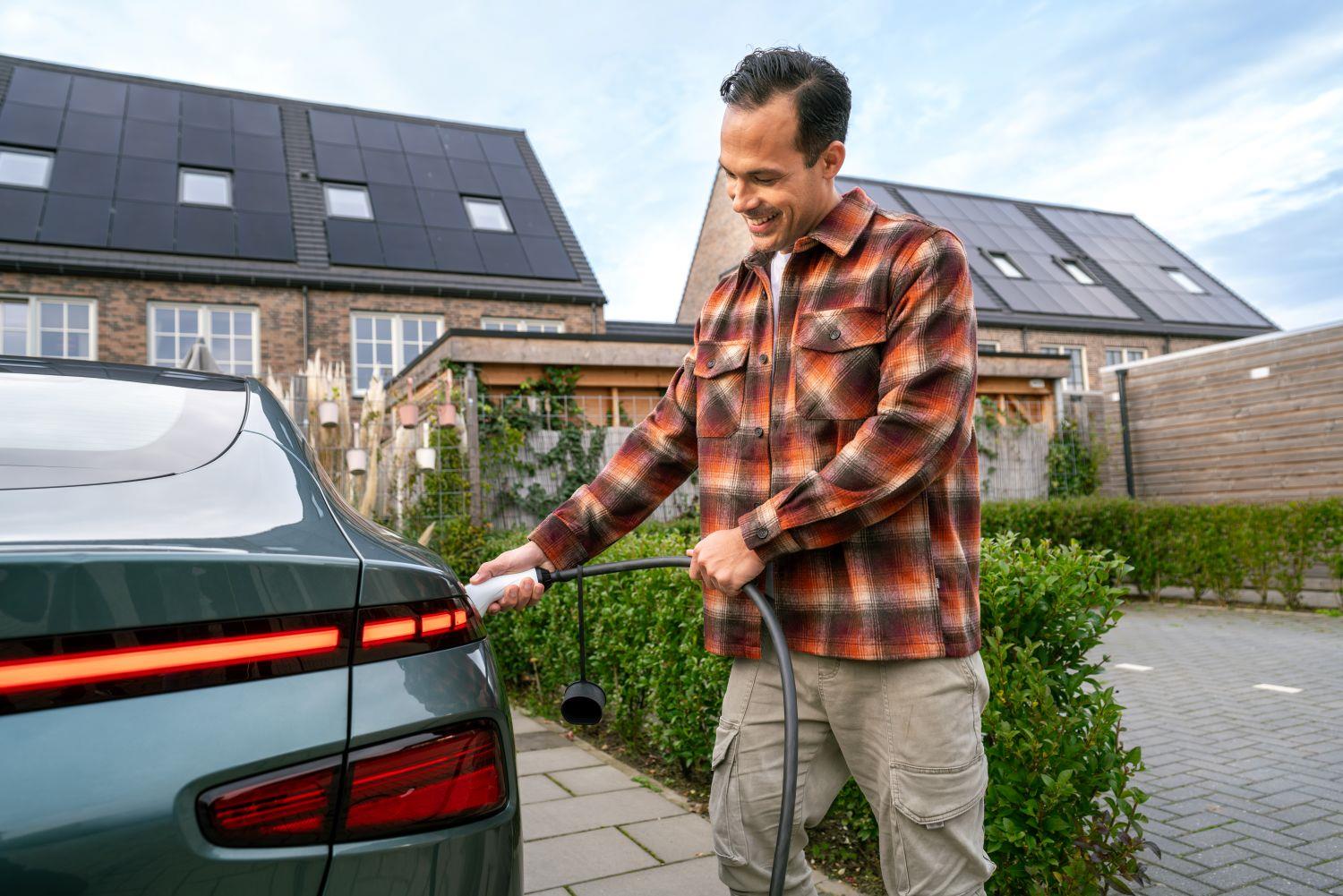
Making logistics more sustainable also has an impact on the electricity grid. The majority of the electricity demand for logistics is situated behind the meter in industrial estates. The same applies to the transition to electric trucks and vans: in order to facilitate this growth in a responsible manner, flexible charging at business parks must become the norm. In collaboration with public authorities, consideration will also need to be given to suitable locations and the design of collective charging stations in order to build a comprehensive charging network.
Making our organisation sustainable
We are aware of the social impact we have as a network operator. That is why we started working in accordance with our CSR policy many years ago. We are now building on that, based on the principle of ‘general prosperity’.
Why this topic is important
We are fully committed to operating as sustainably as possible. Structurally reducing emissions from our work allows us to contribute directly to the achievement of the national climate targets. By working in a circular manner, we can reduce pressure on the availability of raw materials. By setting a good example in this way, we strengthen the confidence of citizens, businesses and authorities in the opportunities offered by sustainability measures and the feasibility of the energy transition.
More information about this topic in the sustainability statementTargeting general prosperity
At Alliander, general prosperity is the anchor point for all our activities relating to corporate social responsibility. We define general prosperity as a situation in which our own prosperity no longer comes at the expense of the prosperity of future generations and prosperity in other parts of the world. At Alliander, we do this by focusing on reducing the demand for energy and infrastructure. In 2025, for example, the Energy Awareness Platform became more clearly defined. In addition to this, we work with clear targets for our own carbon emissions, resource use and biodiversity. We also pay attention to acting fairly as an organisation by closely analysing the social consequences of new tariff structures and our disconnection policy. Everything we develop in the context of general prosperity is now done in collaboration with the other network operators. A few examples from 2025:
Validation of revised CO₂ targets by SBTi
Our participation in the Science Based Targets initiative (SBTi) represents an important positive development in tackling our own carbon emissions and those of our value chain. In 2025, we had our revised CO₂ targets assessed to determine whether they are in line with the Paris Climate Agreement and contribute to limiting global warming to 1.5 degrees. Whereas we previously primarily targeted climate neutrality – reducing and offsetting carbon emissions through measures such as planting trees or purchasing CO₂ credits – we are now focusing on reducing emissions. In addition to having a 100% electric vehicle fleet and climate-neutral buildings, this mainly means reducing gas leaks (leak detection), promoting climate ambitions among our suppliers and reducing the consumption of transported gas by our customers. In 2025, our own organisation's emissions amounted to 176 kilotonnes. This exceeds the target (171) and was caused by disappointing network losses for gas. Last year, our short-term (2026 – 2030) CO₂ targets were validated by the SBTi. This validation confirms that our objectives are transparent and credible, both for our customers and for society.
Clean and emission-free construction
Liander has constructed a cable corridor without producing any emissions for the very first time. This is an important step forward on the path to clean and sustainable construction. Under the Clean and Emission-Free Construction covenant, we are working with the sector to reduce emissions from working vehicles, trucks and vessels. This is how we contribute to meeting national climate and air quality targets and to achieving climate neutrality and circularity in infrastructure projects. As there is still very little experience with emission-free construction in relation to infrastructure, Alliander researched this further in a practice-focused pilot project. In Epe, we constructed a nine-kilometre-long corridor in a Natura 2000 area using electrical equipment such as excavators, cranes and mobile battery packs. Near Den Helder, we carried out drilling work using an 80-tonne electric drilling rig powered by hydrogen fuel cells. These activities provide valuable knowledge about the deployment, planning and charging infrastructure required for zero-emission construction. The experience gained helps us to carry out future projects in a smarter, cleaner and more efficient manner.
Circularity
Working on the energy transition requires large amounts of materials. Alliander believes that respect for people and the environment is paramount here, as we want to make choices that contribute to keeping our planet liveable: we want to build in an energy-efficient way, but we also want to use sustainable materials and help maintain a healthy living environment. At Alliander, our aim is to maximise (re)use of existing materials and circular procurement of what we really need.
In 2025, we purchased 7.5% of our key assets (primary installations) on a circular basis (2024: 6.8%, target for 2025: minimum of 9%). We achieved this by including conditions in tendering processes for cables and distribution transformers to increase the use of recycled raw materials. We also encouraged the market to be creative in adopting circular design and promoting conscious (re)use of materials.
More information about this topic in the sustainability statementHuman rights in the supply chain
In 2025, we drew up our policy on human rights in the supply chain, in line with the due diligence framework of the OECD Guidelines for Multinational Enterprises. In addition to concrete expansion of the scope of our audits and amendments to our Code of Conduct, we are working to increase chain transparency and ensure proactive action in the event of misconduct. Our value chains and the associated risks of human rights violations are often complex and multi-layered. In order to exert sufficient influence and make a real difference, collaboration is essential. That is why we sought collaboration with the other network operators and, for example, trade unions. The due diligence process is continuous and one in which we gain increasing insight into our value chains and become increasingly capable of mitigating our actual risk of human rights violations. The aim is to be at the level of the EU Taxonomy’s minimum safeguards by 2026.
More information about this topic in the sustainability statement
Biodiversity
In 2025, we adopted our first Biodiversity policy plan. This policy guides how we act in respect of biodiversity: nature-inclusive measures such as hedgehog shelters, bat towers and insect hotels have become standard in new construction projects. We are making grid stations greener, making (preliminary) ecological surveys mandatory at the design stage and taking biodiversity into account in site maintenance practices. We have laid this down in policy. With these actions, we are building a solid foundation for a positive impact on nature from 2030 onwards.
Climate change adaptation
Given the low average number of outages, our energy infrastructure is extremely reliable by international standards. At the same time, climate change is leading to an increased risk of damage from drought, rainfall and even flooding. The risk topics are known and we are working to develop a more coherent approach to climate adaptation. In 2025, a project group was formed to bring together all actions and policies as a prelude to a climate adaptation programme. The Dutch sector association, Netbeheer Nederland, is investigating the risks we face at component level. A challenge session with our ExCo members has also been prepared in the context of the Critical Entities Resilience Act (Wet weerbaarheid kritieke entiteiten), which will be organised in the first quarter of 2026.
More information about this topic in the sustainability statement
Energy bank: an energy transition for everyone
’Energy for everyone sounds like something we can take for granted, but for thousands of people it is not,’ says Marije Ruysch, director of the Energiebank for the Arnhem region. ’In the Netherlands, 1.7 million people live more or less on the poverty line. For them, paying their energy bills is often an impossible task. In total, around 116,000 households use hardly any energy, not because they want to save money, but because they have no choice. This means cold homes, stress, health issues, lack of comfort and loneliness behind the front door. People become reclusive; they cannot participate fully in society. A head full of worries and an empty wallet – that is the reality they live in.’
An energy coach visits people at home and initiates action with the home occupants to save energy and analyse their energy bills. ’We attempt to restore comfort, take some of the pressure off people. That is why I am pleased that Alliander renewed our partnership in 2025. Not only financially, but also in terms of content. Alliander looks beyond cables and meters, empathising with the people behind their front doors. Alliander gets to sit at tables that we – and certainly our target group – never get to sit at. They can set the agenda, exert influence and make an impact. That engenders hope. Because energy is a basic necessity of life. Together, we have a goal in sight – ensuring that no one is left out in the cold.’