
Climate change (E1)
Climate change affects Alliander’s value, due to its central position in the energy chain. Energy infrastructure is the crucial facilitating link in the energy chain for the transition to a sustainable, low-carbon energy supply. Our network management activities focus on distributing electricity, gas and heat, and on achieving sustainability in the energy system. Alliander has no business activities in relation to the fossil fuels coal and oil and does not invest in such activities.
Stakeholder expectation
As a network operator, we have a direct and indirect impact on climate through our energy systems. The energy we distribute is partly of fossil origin and this contributes to the climate impact on our stakeholders. They expect Alliander to have an active policy aimed at maximising our contribution to the energy transition goals and limiting climate-related emissions. Alliander is taking various steps to limit climate impact, in which we take account of stakeholder concerns. For instance, we collaborate with non-governmental organisations (NGOs) and other organisations dedicated to the transition to a sustainable energy supply. The starting point for this work is formed by the international climate objectives laid down in the 2015 Paris Climate Agreement and further specified in the Dutch Climate and Energy Agreement. Alliander is working on the implementation of this policy.
Policy and approach
Alliander adheres to the SBTi to limit climate-related emissions from our operations and across our value chains. Since managing climate-related emissions in line with the SBTi reduction pathway is part of our strategy, we have drawn up an action plan that includes a transition plan on how we will be managing our climate impact through to 2030. This plan was approved by the Management Board in mid-2025. In early 2025, we explored the impact of climate change on our assets.
The carbon emissions KPI is part of the dashboard of the topmost management bodies. This KPI covers Scope 1, 2 and 3 emissions of the company’s operations and is also reported on the basis of emissions after decarbonisation measures and reported on every quarter. We set CO2 budgets for each scope. Alliander reports on all emissions categories that are material to its own operations and any part of the chain.
The climate policy and its implementation are managed by the CO2 steering group, which is made up of portfolio holders from the business units that face the most pressing climate issues. The CO2 steering group intervenes based on information provided in the quarterly reports. Progress on policy, targets and actions is regularly evaluated. Targets may be adjusted following changes to material climate impacts, risks and opportunities.
Alliander regularly draws up an energy management plan, which focuses on emissions in the organisation and the value chain. This plan forms part of the CO2 Performance Ladder, for which Alliander is audited annually by Kiwa. Our energy management plan bundles and integrates the various actions, activities and measures aimed at reducing emissions at Alliander and parties across the value chain. The operating targets for CO2, network losses, buildings and transportation have been adopted by the Alliander Management Board.
Our financing policy includes a considerable green finance component. Alliander has the option to issue both bonds and ECP loans to raise capital that can only be used to invest in assets that are defined in detail in the Green Finance Framework. The company also has a committed sustainability-linked credit facility. This financing structure is a financial incentive for Alliander to make sustainable investments and to conduct its business sustainably.
Governance
The energy transition, climate change mitigation and climate change adaptation are integral parts of our strategy and targets. Progress towards our targets from the business plan is monitored through quarterly and annual reports, where achievement and implementation are discussed with management and the process owners. The SBTi targets for the 2026-2030 period serve as input for the business plans of the relevant departments for the coming years.
The targets form part of the dashboard for the topmost management bodies. The approach is approved annually by the Director of Corporate & Social Affairs. Owing to Dutch legislation for public companies such as Alliander, executive and management compensation within the organisation currently includes no financial or other incentives.
Actions
Internal and external validation was completed for the CO2 targets for the 2026-2030 period. For details, see the ‘Science Based Targets initiative’ paragraph.
We are investing not only in mitigation measures focused on energy savings and efficiency in our operations, but also in Guarantees of Origin (GOs).
The climate transition plan for the 2026-2030 period was developed in collaboration with the departments involved. Details of the plan are provided in the ‘About the transition plan’ paragraph.
The CO2 Performance Ladder audit was completed (level 5). See the ‘CO2 Performance Ladder’ paragraph for details.
About the transition plan
Alliander’s climate transition plan is a strategic plan that describes how our organisation will make the transition to a more sustainable energy system. It contains specific steps, targets and measures that we will take to both cut carbon emissions (mitigation) and adapt to the effects of climate change (adaptation). This plan is essential to ensure that we take our share of the responsibility for a sustainable future.
Mitigation
The integrated 2026-2030 transition plan sets out our plans for climate change mitigation within Alliander. In the ‘EU taxonomy’ paragraph, we go into the climate-related KPIs for capital and operating expenditure at corporate level. The KPIs form part of our overall business planning and accountability. The starting points for the transition plan are:
The transition plan is aligned with Alliander’s strategy.
The transition plan is in line with the SBTi framework.
The transition plan is aligned with Alliander’s planning and budget cycle. Our financial planning will incorporate our targets, activities and measures into the budget over several years.
The budget cycle covers the availability of resources and labour, and contains plans for a feasible work package.
Adaptation
Climate risks have been integrated into our risk system and are monitored at the level of the relevant departments. The main risks are flooding, drought and heat, for which we have set up weather protocols, recovery plans and a well-drilled crisis organisation. Alliander has joined forces with Netbeheer Nederland and regional partners to build adaptive infrastructure and develop emergency plans. All the measures have been consolidated in the Climate Change Adaptation framework document that is updated every two years and charts a course for our operational and organisational actions.
Climate change mitigation
The vast majority of Alliander’s carbon emissions are directly related to our core tasks of distributing and transforming electricity and gas. At the same time, these core tasks are a vital part of making the energy transition a reality and thus meeting the national climate targets, for instance by connecting sustainable energy sources to the energy networks and by facilitating the heating transition. We understand mitigation to mean taking measures to reduce greenhouse gas emissions. This includes measures such as switching to green energy sources, improving the energy efficiency of our networks and reducing our energy usage.
Impacts, risks and opportunities
Negative impact – GHG emissions from fossil fuels used internally and in the value chain contribute to climate change.
Potential negative impact – Network expansion and higher loads cause emissions and increase network losses, which contribute to climate change.
Risk – New climate change mitigation regulations lead to higher costs.
Risk – Failure to hit climate targets leads to higher cost of capital.
Opportunity – Using innovative techniques for sustainable energy supply leads to increased revenue or cost savings.
Policy and approach
Alliander pursues a mitigation policy aimed at limiting the company-related CO2e under its immediate control and greening part of its carbon emissions. This policy focuses on:
Scope 1: gas network losses, owned and leased company vehicles, SF6 leaks, buildings and generators.
Scope 2: power network losses and indirect emissions from power and heat consumption in our buildings.
Scope 3: commuting and purchased goods and services.
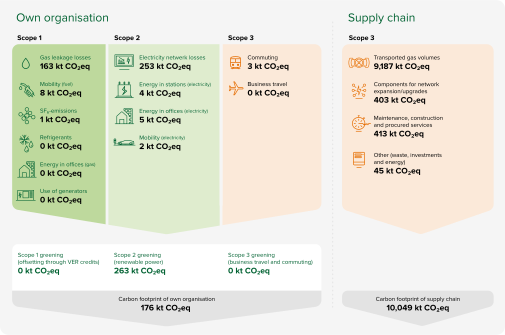
To achieve our targets, we are investing in mitigation measures focused on energy savings and efficiency in our operations. We also invest in GOs. Having taken the next step forward in its climate policy in 2024, Alliander now primarily focuses on reducing and managing rather than offsetting climate-related emissions. Given that Alliander was still awaiting approval of its SBTi target in 2025, a decision was made to follow a simplified SBTi-based reduction pathway that targets an average reduction of 4.2% per year for the organisation as a whole. Our carbon footprint for the year 2025 was as follows:
Objectives
The target for 2025 was to keep carbon emissions from our own operations below 171 kt, and we maintained our ambition to decarbonise our power usage using GOs. We have set reduction targets for each of the three scopes. The starting point for climate change mitigation is that we direct our efforts towards enabling our energy network to facilitate the energy transition and the feed-in of sustainable energy, as well as towards limiting the carbon emissions from our operations.
The carbon emissions from our Scope 2 activities were calculated using the market-based method from the Greenhouse Gas Protocol, factoring in the GOs we purchased, which validate the degree to which the electricity we consumed can be considered renewable. The table in the ‘Climate-related emissions’ paragraph specifies the respective impact of electricity losses and decarbonisation through GOs.
Our targets for 2025 were defined based on the scope classification in the Greenhouse Gas Protocol. This means that we have targets for Scope 1 and 2. For Scope 3, we have only included a target for mobility within our own operations. In anticipation of the new climate target for 2030, we based the reduction rate for the aforementioned categories for the year 2025 on the 1.5°C pathway from the Paris Climate Agreement, as required by the SBTi.
Alliander has adopted 2021 as the base year for reporting on its targets. Since that year, we have complemented our total footprint by an extended Scope 3 analysis.
Science Based Targets initiative
In 2025, the Management Board decided to align the company’s CO2 reduction targets for the 2026-2030 period with the SBTi guidelines, meaning that Alliander’s targets comply with the 2015 Paris Climate Agreement under the 1.5°C pathway. Since SBTi approval was pending for most of 2025, before ultimately being given late in the year, we went by a simplified reduction pathway in line with SBTi in 2025, with an organisation-wide average annual reduction of 4.2%. This validation was approved by the initiative’s Target Validation Board in late 2025, meaning that the following of our targets have now been approved by the SBTi as of 2026:
Given that we have set more ambitious targets for Scope 1 and Scope 2, the focus has now shifted from offsetting emissions to reducing emissions. This includes significant emission sources such as technical and administrative network losses.
We are setting new ambitions for a broader group of Scope 3 emission categories, including emissions from the combustion of distributed gas by end-users.
We are encouraging our suppliers to reduce their emissions and those in their value chain and to set their own science-based CO2 targets.
98% of our total direct (Scope 1 and 2) and indirect (Scope 3) emissions are subject to the 1.5°C pathway from the Climate Agreement.
SBTi targets are converted to maximum carbon emissions by sector and by company on both a domestic and an international level. We have broken the impact down by business unit and assessed it at various levels across the organisation. This has led to a company-wide climate transition plan that will deliver the required reduction by 2030. Alliander’s SBTi-aligned targets are listed in the table in the ‘Climate-related emissions in 2025’ paragraph.
Following the release of the SBTi’s guidance on the SBTi Power Sector Net-Zero Standard in 2025, Alliander sat down with the other network operators in September 2025 to discuss the expected changes and impacts set out in this standard. This led to a joint response that was shared with the SBTi during this consultation round. We are keeping a close eye on this process and are fully aware of possible future changes that may apply to us.
CO2 Performance Ladder
We assess our approach to and the reduction of our climate footprint based on the criteria for the CO2 Performance Ladder. In 2025, we retained our level-5 rating on the Ladder, which is the highest rating,
following Kiwa’s reassessment and reconfirmation of the adequacy and scope of our certificate. Given the adoption of SBTi as the guiding framework, it was decided at the end of 2025 not to continue with the CO2 Performance Ladder. While it has helped our CO2 management mature, the CO2 Performance Ladder has become largely redundant due to the adoption of SBTi.
Climate transition plan and decarbonisation levers
Our climate transition plan contains specific measures and tools called ‘decarbonisation levers’ that we use to bring down our carbon emissions in the short to medium term. These levers help us to achieve our climate targets by 2030 and make a positive contribution to the energy transition. We have opted to use a combination of measures and tools.
Carbon emissions trend
Key Scope 1 and Scope 2 reduction measures in kt CO2e
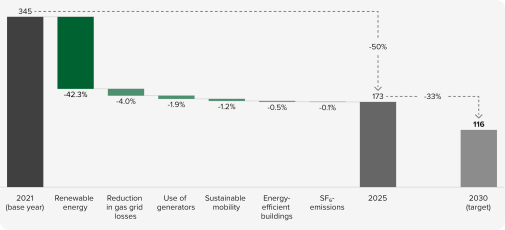
Scope 1 and 2 decarbonisation levers
Renewable energy – electricity network losses
Network losses can roughly be broken down into three parts. About half of these losses are so-called ‘transmission losses’, i.e. losses created during energy transmission, such as the heat dissipated by cables and transformers. Additionally, around 30% of network losses can be attributed to unpaid consumption, which is caused by administrative errors in metering and master data, by situations where consumption has not been linked to a market party (such as when electricity is consumed without a contract or in a vacant property), as well as by theft and fraud. Finally, roughly 20% is made up of electricity consumption by the network itself, such as metering equipment and transformers. Alliander has set itself the goal of fully offsetting the carbon emissions associated with the production of the electricity used to compensate for our network losses by 2030, which Alliander intends to do by using GOs.
Alliander is actively working to reduce technical network losses in the power grid by using thicker cables, more efficient transformers and shorter stretches of cable. The internal price of network losses, which also includes Alliander’s internal carbon price of €150 per tonne, ensures that investments to cut energy losses and emissions are prioritised in our decision-making. This ensures that CO₂ reduction is systematically considered in our technical and operational choices, while the actual impact still depends on the emission factor of the electricity mix and external market developments.
Liander maintains a continuous focus on reducing network losses caused by unpaid consumption, with departments that deal with connections without a contract, theft and fraud, with various kinds of reporting used to reduce metering and master data errors, and with ongoing initiatives to improve tracking of consumption, for example, at the level of network connections and medium-voltage stations. The resulting insights help detect and resolve metering and master data errors.
Carbon emissions resulting from technical and administrative network losses are fully offset using certificates for Dutch GOs.
Reduction of gas network losses – technical
Methane emissions caused by technical network losses from the gas transmission network make up a substantial part of our direct emissions, partly because this gas is a significantly stronger greenhouse gas than CO2. Both fossil natural gas and renewable natural gas, also known as ‘green gas’ or ‘biomethane’, have high methane content that causes technical network losses to directly contribute to climate change. Technical network losses occur partly due to leaks in our gas transmission network caused by ageing infrastructure, soil movement or corrosion, but also during excavation and maintenance work on our gas grid (burning off and flaring). Reducing technical network losses, and with that methane emissions, is essential to achieving our climate targets.
Alliander complies with the EU Methane Regulation (2024) and has aligned its policies accordingly. In 2025, we introduced an innovative leak detection method in the form of a gas leak detection vehicle with smart calculation models. This vehicle, equipped with state-of-the-art sensors and sophisticated calculation models, detects methane in the atmosphere and calculates emissions per leak in grams per hour. The resulting data empowers us to act more quickly and efficiently through targeted repairs, while also improving our estimates of methane emissions from our network. Additionally, we are continuing our policy of accelerated replacement of pipelines that are vulnerable to breakage and corrosion, such as grey cast iron pipelines. These replacements are carried out in accordance with agreements with the relevant regulatory authority, i.e. the Dutch State Supervision of Mines (SodM). However, the net emission reduction delivered by this measure is limited and will decline further as more leaks are repaired and the regulation requires us to scale up the inspection frequency for these materials.
Although complete elimination of methane emissions is not feasible as long as the gas network remains operational, our goal is to significantly reduce these emissions by 2030. We expect the annual reduction rate to rise from 2026 onwards, as the roll-out of the new detection method makes us more effective in prioritising gas leak repairs.
Reduction of gas network losses – administrative
Administrative network losses occur when gas is not correctly allocated to end-users, rather than gas physically being released into the atmosphere. Such losses can result from metering errors, incorrect or missing readings from traditional meters, connections without a contract or energy fraud. Although these losses are less visible than physical leaks, they do contribute to our carbon footprint when the misallocated gas is burnt. As a network operator, Alliander is responsible for procuring gas to compensate for network losses and managing administrative network losses.
We are currently exploring various approaches to reduce administrative gas losses, looking for ways to invoice and allocate more of the non-contracted consumption to the actual end-user, to ensure that the associated carbon emissions can be attributed where they were generated. Additionally, we are monitoring developments in green gas certificates and the blending obligation that will come into effect from 2027 to explore how these can further contribute to reducing and compensating administrative network losses. Based on the above measures, we have developed several scenarios to meet the desired reduction target. As for technical network losses, we believe that, based on our transition plan, the targeted reduction by 2030 compared to 2021 is realistic.
Use of generators
Due to increasing network congestion, customer reimbursements for generators are gradually decreasing, and we use generators ourselves in exceptional cases only. Whenever we do use a generator, we always run it on HVO fuel. This has already brought down emissions and is expected to completely eliminate these kinds of emissions by 2030.
Sustainable mobility
Alliander has a sustainable mobility strategy that revolves around electrification of its vehicle fleet. Employees with a company-leased vehicle can only choose fully electric vehicles. For company vehicles, we go by an ‘EV unless’ policy that sees us steadily move towards a fully electric fleet. We are also taking steps when it comes to our vans, as we require 75% of vans up for replacement to be replaced with an electric van, unless this is not possible. The transition to electric vehicles is not uniform across all vehicle types. We are taking a phased approach to preparing our technicians and units for electric vehicles, and then company vehicles and commercial vans in particular. Clear communication and proper guidance are crucial to keep the transition moving forward and realise our ambitions.
Electric vehicles not only help reduce emissions, they are also the only way we can keep accessing zero-emission zones in city centres. This policy is expected to result in a 79% emission reduction by 2030 compared to 2021.
In 2026, we will take our efforts in this context to the next level by introducing a new mobility policy that emphasises sustainable and healthy choices. We promote active transportation and cleaner mobility, while discouraging fossil-fuelled mobility options. With this approach, we aim to limit the growth of emissions from commuting (Scope 3) and achieve reductions compared to a reference scenario without additional measures.
Energy-efficient buildings
Our buildings and their management remain an important focus area within our transition, as we strive to have offices that are energy efficient and in some cases circular. Thanks to the sustainability improvements we made in recent years, an analysis has shown that we already meet the CO₂e reduction requirements under the SBTi Buildings Criteria, which provide guidelines for real estate. This made us decide not to set a separate target for our buildings, since it has already been met. Carbon emissions from our buildings are, however, included in our overall Scope 1 and 2 targets. For all our real estate, we align with the Dutch ‘Paris Proof’ standard, which focuses on actual energy consumption (kWh/m²) and thus puts the accent on energy efficiency. Since 2021, gas consumption has fallen by over 80%. For our buildings and sites, we are committed to sustainable generation, alternative heat sources, insulation and energy certification, as we aim to improve efficiency despite the expected growth of our workforce.
We have recorded the required investments in ‘Paris Proof’ roadmaps that include measures and investments that deliver the targeted energy and CO₂ reductions. These roadmaps have been embedded in our Facilities unit’s long-term plan. Additionally, we have integrated the sustainability objectives into Alliander’s management, procurement and leasing policies.
SF₆ emissions
A potent synthetic greenhouse gas, sulphur hexafluoride (SF₆) is used for its outstanding insulating properties. However, it may also be emitted to the atmosphere during the production, installation, maintenance and decommissioning of installations.
Alliander has started to replace older installations and is placing greater emphasis on maintenance, in part through stricter policies and an improved reporting system that is coordinated with other network operators. As of 1 January 2026, new legislation requires a phased introduction of SF₆-free installations. The use of new SF₆ will be completely prohibited from 2035. We expect to achieve our targets by persevering with our current policy, which is expected to stabilise SF₆ emissions and the associated CO₂ equivalents. To prevent any increase in SF₆ emissions, larger installations will also be overhauled. We expect the final remaining SF₆-containing installations to be part of the network until 2078.
Scope 3 measures
Procurement from value chain partners
When it comes to carbon emissions from Alliander’s procurement activities, our supplier engagement initiatives form a crucial decarbonisation lever in our climate transition plan. Alliander aims for suppliers, who are responsible for the majority of our upstream Scope 3 emissions (at least 80% of emissions) within the categories of purchased goods and services, capital goods and transportation, to commit to setting their own science-based targets (SBTs) or comparable climate objectives. This means that suppliers must have committed to SBTi or equivalent science-based targets by 2030 at the latest, i.e. five years after we start setting our own targets in 2026.
To achieve this, we are focusing efforts on targeted dialogue, monitoring and collaboration with suppliers. In addition to achieving our main target, we are integrating climate performance into our procurement criteria and contract terms. This approach will enable us both to reduce our own emissions and contribute systematically to the sustainability of the value chain.
Emissions from the combustion of distributed gas by end-users
Within our climate targets, the reduction target for emissions resulting from the combustion of the gas we transport presents a complex challenge. As a gas network operator, we are legally required to continue transporting natural gas. At the same time, however, the SBTi framework requires us to cut Scope 3 carbon emissions by at least 42% by 2030, compared to the base year 2021.
Accelerating the execution of our core tasks, such as expanding electricity networks and enabling green gas distribution, will allow us to indirectly contribute to bringing down natural gas demand among our customers. While we actively promote energy savings and the transition to sustainable alternatives, we realise that this is a shared responsibility where our direct influence is limited,
which leaves us in a challenging balancing act. On the one hand, the scale of these carbon emissions in our value chain is largely determined by factors beyond our operational control, such as government policy, energy market prices, weather conditions and end-user choices, while on the other we remain legally responsible for gas transport. Over the coming years, we will increase transparency regarding these emissions and assess specifically where our influence is real and demonstrable, and where it is not. This clarification will feed into realistic targets and credible reduction pathways as part of our commitment to the SBTi framework.
Climate-related emissions in 2025
Adjustment of comparative figures on carbon emissions
Where possible, we disclose quantitative data in the table below, including comparative figures from the previous year and the base year, to provide context and comparability. In 2025, the greenhouse gas emissions disclosed for 2021 and 2024 were partially recalculated and corrected. On the one hand, this involved adjustments to the measurement and recognition of network losses for electricity and gas within Scope 1 and Scope 2, and on the other, an update of the emission factor set for the spend-based method within Scope 3 following the transition from DEFRA 2011 to DEFRA 2022.
The effect varies by scope. Within Scope 1 and Scope 2, the differences are related to recalculations and corrections in the measurement and recognition of network losses for electricity and gas, including the correction of volumes previously recorded as administrative network losses but subsequently invoiced to end-users, as well as the assumptions applied. For 2021, this resulted in Scope 1 emissions being 5 kt CO₂e lower, location-based Scope 2 emissions being 11 kt CO₂e lower and market-based Scope 2 emissions being 3 kt CO₂e lower.
For 2024, differences in the figures arise from the same method, supplemented by reconciliation corrections for the previous year’s volumes, as initial allocations based on profiles were subsequently adjusted using actual meter readings. For further details, see note 35 to the financial statements. As a result of the adjustment, Scope 1 emissions were 27 kt CO₂e lower, location-based Scope 2 emissions were 12 kt CO₂e lower, while market-based Scope 2 emissions remained unchanged.
The updated emission factors for the spend-based method resulted in Scope 3 emissions turning out 65 kt CO₂e higher in 2021 and 157 kt CO₂e higher in 2024, compared to the figures disclosed in the 2024 annual report. The table below shows both the previously disclosed figures and the recalculated figures.
|
tonnes of CO2 equivalent |
Reported 2021 |
Recalculated 2021 |
Reported 2024 |
Recalculated 2024 |
|
Direct GHG emissions (scope 1) |
204,031 |
199,156 |
171,525 |
144,581 |
|
Indirect GHG emissions (scope 2) |
||||
|
Location-based |
588,693 |
577,257 |
369,939 |
357,664 |
|
Market-based |
149,065 |
146,211 |
22 |
22 |
|
Upstream indirect GHG emissions (scope 3) |
||||
|
C1. Purchased goods and services |
205,830 |
218,632 |
304,192 |
321,765 |
|
C2. Capital goods |
164,382 |
217,450 |
205,265 |
339,663 |
|
C3. Fuel- and energy-related activities |
112,019 |
112,019 |
17,318 |
17,318 |
|
C4. Upstream transportation and distribution |
13,977 |
16,058 |
9,514 |
11,318 |
|
C5. Waste generated in operations |
2,562 |
2,562 |
2,597 |
2,597 |
|
C6. Business travel |
64 |
64 |
231 |
231 |
|
C7. Employee commuting |
1,421 |
1,421 |
2,618 |
2,618 |
|
C15. Investments |
6,399 |
3,101 |
4,095 |
7,438 |
|
Total upstream indirect GHG emissions (scope 3) |
506,654 |
571,307 |
545,829 |
702,948 |
|
Total GHG emissions (location-based) |
1,299,377 |
1,347,720 |
1,087,293 |
1,205,193 |
|
Total GHG emissions (market-based) |
859,749 |
916,674 |
717,376 |
847,550 |
Emissions trend and reduction in carbon emissions
Alliander uses 2021 as the reference year for comparison of energy and carbon emissions data. That year, Alliander’s carbon emissions from its own operations, i.e. Scope 1, Scope 2 and Scope 3 transportation emissions, totalled 512 kt CO₂ without offsetting through GOs. Total carbon emissions in 2025 were 439 kt CO₂ (2024: 378 kt CO₂), which represents a 14% drop on 2021 and a difference of 73 kt.
|
tonnes of CO2 equivalent |
Target |
|||||
|
2021 |
2024 |
2025 |
% 2025 / 2024 |
2026 |
2030 |
|
|
Direct GHG emissions (scope 1) |
||||||
|
Use of generators |
6,677 |
48 |
36 |
31 |
||
|
Refrigerants |
67 |
67 |
78 |
67 |
||
|
Gas usage in buildings |
2,014 |
312 |
383 |
338 |
||
|
SF6 emissions |
1,441 |
1,920 |
1,149 |
1,033 |
||
|
Lease & company cars |
12,148 |
9,111 |
7,963 |
5,006 |
||
|
Gas network losses, administrative |
81,097 |
47,658 |
77,598 |
40,767 |
||
|
Gas network losses, technical |
95,712 |
85,465 |
85,465 |
67,486 |
||
|
Total indirect GHG emissions (scope 1) |
199,156 |
144,581 |
172,672 |
19% |
114,726 |
42% |
|
Indirect GHG emissions (scope 2) |
||||||
|
Location-based1 |
||||||
|
Heat consumption in buildings |
209 |
102 |
88 |
93 |
||
|
Lease & company cars |
985 |
1,733 |
2,074 |
2,346 |
||
|
Electricity consumption in buildings |
3,322 |
2,150 |
2,007 |
2,244 |
||
|
Electricity consumption in stations |
4,963 |
3,373 |
2,793 |
2,459 |
||
|
Electricity network losses, administrative |
185,401 |
114,388 |
89,425 |
95,535 |
||
|
Electricity network losses, technical |
382,378 |
235,918 |
184,433 |
197,035 |
||
|
Total location-based |
577,257 |
357,664 |
280,820 |
-21% |
299,712 |
|
|
Market-based2 |
||||||
|
Heat consumption in buildings |
32 |
22 |
19 |
24 |
||
|
Lease & company cars |
587 |
- |
- |
- |
||
|
Electricity consumption in buildings |
1,566 |
- |
- |
- |
||
|
Electricity consumption in stations |
2,339 |
- |
- |
- |
||
|
Electricity network losses, administrative |
53,938 |
- |
- |
- |
||
|
Electricity network losses, technical |
87,748 |
- |
- |
- |
||
|
Total market-based |
146,211 |
22 |
19 |
-10% |
24 |
-100% |
|
Upstream indirect GHG emissions (scope 3)3 |
||||||
|
C1. Purchased goods and services |
218,632 |
321,765 |
403,286 |
|||
|
C2. Capital goods |
217,450 |
339,663 |
413,450 |
|||
|
C3. Fuel- and energy-related activities |
112,019 |
17,318 |
20,402 |
|||
|
C4. Upstream transportation and distribution |
16,058 |
11,318 |
9,298 |
|||
|
C5. Waste generated in operations |
2,562 |
2,597 |
3,333 |
|||
|
C6. Business travel |
64 |
231 |
214 |
|||
|
C7. Employee commuting |
1,421 |
2,618 |
2,753 |
|||
|
C15. Investments |
3,101 |
7,438 |
12,005 |
|||
|
Total upstream indirect GHG emissions (scope 3) |
571,307 |
702,948 |
864,741 |
23% |
||
|
Total GHG emissions (location-based) |
1,347,720 |
1,205,193 |
1,318,233 |
9% |
414,439 |
|
|
Total GHG emissions (market-based) |
916,674 |
847,550 |
1,037,433 |
22% |
114,751 |
|
- 1Total greenhouse gas emissions under the location-based method are calculated using the average emission factors for the national electricity grid. This means that carbon emissions per kWh consumed are multiplied by the average emission factor for the Dutch energy mix, disregarding any individual contracts for renewable energy such as GOs.
- 2Market-based Scope 2 emissions include the effect of using renewable energy through the purchasing of GOs. These are used to bring carbon emissions from electricity consumption down to 0 tonnes of CO₂ equivalent. A total of 1,645 kt, 231 kt and 263 kt of CO₂ equivalent were offset using GOs in 2021, 2024 and 2025 respectively. Our target for 2025 is to offset 304 kt of our electricity consumption using GOs.
- 3Not all Scope 3 categories are applicable to Alliander. Categories C8, C9, C10, C11, C12, C13, and C14 are not disclosed because they are either entirely absent or only marginally present in Alliander’s value chain and therefore not material. For Scope 3, Alliander has not yet set an absolute target for 2030. Alliander will do this in 2026 in line with the SBTi framework.
Climate footprint development and results for 2025
95% of CO₂e emissions from Alliander’s own organisation were caused by network and leakage losses that arose mainly from the distribution of electricity and gas, compared to 96% in 2024. We are working to reduce our technical and administrative network losses each year by using measures such as an internal carbon price. The network losses percentage is an accurate approximation. Assumptions and estimates are used when calculating the carbon footprint and energy usage. Since 2016, the CO₂ emission factor for electricity network losses has been calculated on the basis of energy purchased from our suppliers to cover network losses. The 2024 electricity labels were used for the 2025 annual report, returning a CO₂ coefficient of 0.2024 kg CO₂ per kWh (2024: 0.16889 kg CO₂ per kWh). In 2025, 58% of the organisation’s gross carbon emissions were caused by electricity network losses (2024: 58%). The emission factor for 2024 (0.16889 kg CO₂ per kWh) was recalculated based on the most recent electricity labels. In the 2024 annual report, we used a factor of 0.19318 kg CO₂ per kWh.
Scope 1 emissions
Our Scope 1 emissions come from the use of generators, coolants, natural gas to heat our offices, SF₆ emissions from switchgear, fuel consumption (owned and leased company vehicles), and gas network and leakage losses. In 2025, Scope 1 emissions totalled 173 kt CO₂e, up 28 kt on the adjusted figure for 2024 (145 kt CO₂e). The increase is mainly due to gas network losses. This is related to a reconciliation and adjustment of the gas network loss figure for 2024, as network losses were revised downward by 12 million m³ in 2024 based on the most recent available data. For 2025, network losses are expected to be 7 million m³ higher than in 2024. Emissions from gas network and leakage losses amounted to 163 kt CO₂e in 2025. Administrative network losses totalled 78 kt CO₂e (2024: 48 kt CO₂e), while technical network losses amounted to 86 kt CO₂e (2024: 86 kt CO₂e).
Emissions from owned and leased company vehicles totalled 8 kt CO₂e in 2025 (2024: 9 kt CO₂e). These emissions fell on the back of further electrification and the introduction of medium-sized electric vehicles. At the same time, a number of diesel vehicles will continue to be necessary to carry out work. Given the relatively minor emissions in the other Scope 1 categories, these do not significantly affect the overall picture.
Scope 2 emissions
Our Scope 2 emissions originate from the generation of the electricity and heat we purchased for our buildings and stations, as well as from electricity network losses and the charging of owned and leased company vehicles. In this section, we will provide further details of electricity network losses, as these are the main driver of the trend in Scope 2 emissions. In 2025, the total location-based emissions amounted to 281 kt CO₂e, down 77 kt CO₂e on 2024 (358 kt CO₂e). The reduction came largely as a result of a drop in electricity network losses.
Electricity network losses can be broken down into technical and administrative losses. Technical network losses occur during the transport of electricity through the grid. Administrative network losses are related to factors such as energy fraud and connections for which no formal contract has been signed. Total electricity network losses fell by 52,621 MWh in 2025 compared to 2024, from 1,297,428 MWh to 1,244,807 MWh. In terms of CO₂ equivalents (for the location-based method), emissions from electricity network losses declined from 350 kt CO₂e in 2024 to 274 kt CO₂e in 2025. This reduction is related to a drop in network losses, partly due to the transfer of the Randmeren high-voltage line to TenneT in early 2025, which meant that the associated network losses were no longer attributed to Liander.
Scope 2 emissions are disclosed using both the location-based and the market-based method. Market-based Scope 2 emissions were 0 kt CO₂e (rounded down) in 2025 (2024: also rounded down to 0 kt CO₂e). Market-based emissions from purchased electricity amounted to zero because GOs were used and cancelled for all Scope 2 electricity consumption. The gross emissions associated with our Scope 2 electricity consumption totalled 231 kt CO₂e in 2024 and 263 kt CO₂e in 2025, with the gross market-based portion of these emissions from electricity network losses coming in at 221 kt CO₂e in 2024 and 253 kt CO₂e in 2025. Although network losses were down in 2025, gross market-based emissions before allocation of GOs were up. This was because the average CO₂ emission factor of electricity purchased to cover network losses in 2025 was higher than in 2024 due to a change in the procurement mix and associated electricity labels. The remaining emissions related to heat and totalled 19 t CO₂e, which has been rounded down to 0 kt CO₂e.
Scope 3 value chain emissions
In 2025, total Scope 3 emissions came in at 865 kt CO₂e (2024: 703 kt CO₂e), up 162 kt CO₂e (23%). This increase was almost entirely driven by category 1 (purchased goods and services) and category 2 (capital goods). Looking solely at non-rounded values, these two categories jointly were up by 156 kt CO₂e, which accounts for approximately 96% of the total increase. Category 1 rose from 322 kt CO₂e in 2024 to 403 kt CO₂e in 2025, while category 2 increased from 340 kt CO₂e to 413 kt CO₂e.
Category 1: purchased goods and services
Category 1 emissions amounted to 403 kt CO₂e in 2025 (2024: 322 kt CO₂e). For this category, Alliander used a spend-based method, because detailed emission data from suppliers was largely lacking.
The increase of approximately 82 kt CO₂e in 2025 was mainly due to higher expenditures in contracting because of the larger work package for grid upgrades, expansion and replacements.
Category 2: capital goods
Category 2 emissions amounted to 413 kt CO₂e in 2025 (2024: 340 kt CO₂e). For this category, we used a combined method that involved calculating part of the emissions based on volume data from raw material passports, combined with environmental factors from Delft University of Technology’s Idemat database. The remaining part was calculated using the spend-based method, based on DEFRA emission factors, including CPI indexing.
The rise in 2025 was mainly driven by the volume-based part (+45 kt CO₂e). This was due to increased use of materials, including aluminium, steel, copper and printed circuit boards, combined with increased material consumption and higher emission factors per kilogram of material. The spend-based part was up 29 kt CO₂e.
Emissions in the other Scope 3 categories were relatively minor compared to categories 1 and 2 and do not significantly alter the overall picture.
Total emissions according to the SBTi target boundary (including combustion of distributed gas by end-users)
In addition to the disclosure of total greenhouse gas emissions under the ESRS in the ‘Emissions trend and reduction in carbon emissions’ table, Alliander also discloses a summary of total emissions according to the SBTi target boundary for the purposes of monitoring and transparency. This summary includes Scope 1, Scope 2 and Scope 3 upstream emissions, plus emissions generated when end-users burn the natural gas that was transported through our gas network. Since Alliander does not sell the natural gas directly to these end-users and does not have economic ownership of it, these emissions are disclosed in a separate table rather than within the ESRS Scope 3 category breakdown in the carbon emissions table.
Total greenhouse gas emissions were up 516 kt CO₂e, rising from 9,708 kt CO₂e in 2024 to 10,224 kt CO₂e in 2025. This rise came largely on the back of end-user emissions from the combustion of natural gas distributed through Alliander’s gas network. These emissions increased to 9,187 kt CO₂e in 2025 (90% of the total GHG emissions), compared to 8,861 kt CO₂e in 2024 (91% of the total GHG emissions), mainly as a result of an increase in the total volume of natural gas transported as cold weather conditions pushed up demand for heat. However, after a temperature correction based on the number of heating degree days, the volume in 2025 was down approximately 110 million m³ on 2024 (about 2.2%), which represents a reduction of around 195 kt CO₂e.
In addition, Scope 3 upstream emissions increased by approximately 162 kt CO₂e, while Scope 1 emissions rose by around 28 kt CO₂e. Scope 2 emissions were still minor in both years. Electricity purchased and consumed by Alliander was certified as renewable energy through GOs. In 2025, 263 kt CO₂e was accounted for in this manner, compared to 231 kt CO₂e in 2024 and 165 kt CO₂e in 2021.
For further details on Scope 1, Scope 2 and Scope 3 (upstream) emissions, see the ‘Climate-Related Emissions 2025’ paragraph.
|
Greenhouse gas emissions (tCO2eq) |
2021 |
2024 |
2025 |
% 2025 / 2021 |
2030 |
|
Direct GHG emissions (scope 1) |
199,156 |
144,581 |
172,672 |
-13% |
42% |
|
Indirect GHG emissions (scope 2 market-based) |
146,211 |
22 |
19 |
-100% |
-100% |
|
Upstream indirect GHG emissions (scope 3) |
571,307 |
702,948 |
864,741 |
51% |
|
|
Emissions from combustion of transported natural gas (end users) |
9,186,756 |
8,860,745 |
9,186,756 |
0% |
42% |
|
Total greenhouse gas emissions, market-based (tCO2eq) |
10,103,430 |
9,708,295 |
10,224,189 |
1% |
CO₂ intensity ratios
Greenhouse gas intensity reflects the ratio of total greenhouse gas emissions to the net revenue from activities in the ‘distribution and transformation of electricity’ sector (NACE D35), plus the distribution of gas. The trend in greenhouse gas intensity is primarily driven by changes in total greenhouse gas emissions and net revenue. In this regard, emissions are influenced mainly by Scope 1 and 2 emissions from network management operations, the volume of natural gas burnt by end-users and indirect upstream emissions (Scope 3), particularly in category 1 (purchased goods and services) and in category 2 (capital goods).
In 2025, greenhouse gas intensity was down slightly compared to 2024. Location-based intensity was down 3%, from 3,308 to 3,210, and market-based intensity fell by 2%, from 3,190 to 3,124. This drop in intensity came primarily as a result of net revenue growing 7.6% from €3,043 million to €3,273 million, while total greenhouse gas emissions showed only a modest increase of 4% and 5% for location-based intensity and market-based intensity respectively. The increase in CO₂e is largely caused by emissions at end-users from the combustion of natural gas distributed through our gas network. This results from higher gas transmission volumes due to an increase in heat demand due to weather conditions. As a result, CO₂e emissions per billion euros of revenue fell slightly.
When not including emissions at end-users from the combustion of gas distributed through our gas network, intensity amounted to 403 tonnes CO₂e per million euros of revenue under the location-based method (2024: 396 tonnes, +2%) and 317 tonnes CO₂e per million euros of revenue under the market-based method (2024: 279 tonnes, +14%). This uptick was driven by a rise in indirect upstream emissions in Scope 3 due to increased operational activities, particularly in category 1 (purchased goods and services) and in category 2 (capital goods). In addition, direct Scope 1 emissions rose due to higher network losses in the gas grid.
|
Greenhouse gas intensity by net revenue (tCO₂eq/€ million) |
2021 |
2024 |
2025 |
% change in 2025 compared to 2024 |
|
Location-based emissions |
636 |
396 |
403 |
2% |
|
Market-based emissions |
432 |
279 |
317 |
14% |
Carbon emission reduction through decarbonisation using GOs
Part of Alliander’s policy involves decarbonising electricity network losses by generating additional energy from renewable sources in the Netherlands. In 2025, we offset 253 kt CO₂e of our total electricity network losses using GOs from Dutch wind certificates (2024: 230 kt CO₂e). In addition, we used 23,320 MWh of green power in our buildings, which corresponds to 9 kt CO₂e. For EV charging outside our buildings, we used 5,164 GOs, which translates to 2 kt CO₂e. In 2025, we decarbonised 100% of the total electricity network losses using Dutch wind certificates by activating additional contractually secured green certificates. Alliander assesses the supplier of the certificates against the supplier criteria in its general procurement policy. This approach ensures that our network losses are low-carbon and supports growth in renewable energy generation.
The reliability of purchased GOs is guaranteed by VertiCer criteria. The GO system is designed to prevent double counting of avoided carbon emissions. One GO represents one megawatt of sustainable electricity. If a country exports a GO to another country, the avoided emissions can no longer be counted in national reporting to the European Commission. This rule applies to all European countries, as well as to countries with which the European Commission has agreed a sustainability target. After decarbonisation, our footprint for Scope 2 emissions was 0 kt CO₂e in 2025 (2024: 0 kt CO₂e).
No other carbon offsetting using carbon credits
Until 2024, Alliander decarbonised all its other emissions, such as those associated with gas network losses, commuting and business travel in Scope 3, using (Gold Standard) carbon credits. Alliander ceased the use of carbon credits in 2025. Following the switch to the SBTi framework, the use of (Gold Standard) carbon credits is no longer relevant, because they are not permitted.
Internal carbon price
We use an internal carbon price as a weighting factor when assessing our investments. Energy savings or reductions in methane leaks are assigned greater weight as a result. In 2020, Alliander took the initiative to persuade all the network operators to reach a sector-wide agreement on (higher) internal carbon pricing, and in 2021 the network operators resolved to use the same carbon price of €50 per tonne and to raise it progressively over time. The network operators raised the internal carbon price to €100 per tonne in 2022 and to €150 per tonne in 2023. In 2024, the internal carbon price was kept at €150 per tonne. The internal carbon price also remained unchanged in 2025.
When assessing our tenders, we include the energy consumption of components during their service life as far as possible. Given the volumes we purchase, we are always looking for improvements in this area. Working with an internal carbon price ensures stronger prioritisation of higher CO₂ reductions in respect of our own investments and the components we purchase from others. We are finding that price rises in the energy market, together with our tender specifications regarding energy efficiency in combination with carbon pricing, are making a clear difference. The internal carbon price is a shadow price and has no impact on the company’s financial statements.
Carbon price types used
The internal carbon price of €150 per tonne forms part of the Price of Network Losses. The Price of Network Losses is a shadow price used to incorporate network losses and the associated carbon emissions into investment decisions and business cases. The figure of €150 is based on the ‘prevention price’ for CO₂. This is higher than the market price in the European Emission Trading System (ETS) and is also ‘consensus-based’ within our sector. In 2025, a more extensive integrated sensitivity analysis of the core processes in case of future rises in the carbon price was completed. The thresholds for various investments were reviewed again, as well as the level (carbon price) that aligns best with the other network operators. The idea is to prevent excessive market distortion (exclusion of suppliers or price disruptions) and ensure that investments in the energy grid for the energy transition are not undermined. The recommendations made based on the sensitivity analysis do not suggest that the carbon price needs to be increased in the short term.
Basis of greenhouse gas emissions disclosure and methodology
Alliander discloses greenhouse gas (GHG) emissions in line with the Greenhouse Gas Protocol (GHG Protocol), as required under ESRS E1. For Scope 1, 2 and 3, the operational control method is applied. Disclosed Scope 1 emissions comprise carbon dioxide (CO₂), methane (CH₄) and sulphur hexafluoride (SF₆). Alliander is not governed by the provisions of the ETS. Within Scope 2, no biomass is used for energy generation, which is why no biogenic carbon emissions from combustion or biodegradation are disclosed. Biogenic emissions related to green gas feed-in fall outside the boundary of our CO₂e footprint and are not included. In 2025, it was determined that these emissions are not material in the context of SBTi accreditation. Compared to 2024, biogenic emissions remained largely unchanged.
Location-based and market-based Scope 2 emissions
In Scope 2, we disclose both location-based and market-based emissions, as per the GHG Protocol. Under the location-based method, emissions are calculated using the average emission factor for the Dutch power grid, as published on CO2emissiefactoren.nl. Under the market-based method, supplier-specific and product-specific emission factors are applied based on electricity labels and supplier information. Since electricity labels relate to the previous year, emissions are updated in the subsequent reporting year based on the most recent labels. For Scope 2 electricity consumption, GOs are used and cancelled, validating the market-based allocation of electricity as renewable. Scope 1 and 2 emission factors and critical estimates
Emission factors published on CO2emissiefactoren.nl were used for Scope 1 and the location-based Scope 2 method. For items based on estimates, including gas network losses and electricity network losses, final metering and payment data in the sector may be updated over a longer period. Volumes of both gas and electricity network losses were partly determined based on estimates and subsequently adjusted through reconciliation. See note 35 to the financial statements (critical accounting policies).
Scope 3 principles and data quality
Calculating Scope 3 emissions entails a greater degree of uncertainty than calculating those in Scope 1 and Scope 2. This is because a significant share of these emissions lies outside of Alliander’s direct sphere of influence and we partly rely on information from external parties when calculating these emissions. Where such primary data is unavailable, we use secondary data and assumptions.
Breakdown of methods used for each Scope 3 category
For Scope 3, we applied a combination of methods, depending on data availability.
Spend-based method
Where physical data was unavailable, emissions were calculated based on procurement expenditure and spend-based emission factors. For this year’s annual report, we used DEFRA 2022 emission factors. The comparative figures and the base year were also recalculated using DEFRA 2022 emission factors to ensure consistency across the time series. For the 2024 annual report, we used DEFRA 2011 emission factors. Procurement data in euros is converted to pound sterling (GBP) at the exchange rate as it was on 31 December of the relevant reporting year. The set of emission factors is updated to the reporting year through indexation using CPI inflation figures for the Netherlands. This method was applied to category 1 (purchased goods and services) and to the spend-based portion of category 2 (capital goods), as well as to other categories where relevant and where physical data was not available.
Use of physical data where available
Where possible, physical data was used, including raw material passports and life cycle data from Delft University of Technology’s Idemat database. For category 2 (capital goods), we applied a hybrid approach, calculating emissions for the part with raw material passports based on material volumes and LCA data, and using the spend-based method for the remainder. To avoid double counting, expenditures relating to components for which raw material passports were provided were excluded from the spend-based calculation.
Emissions from gas consumption by end-users
Emissions generated when end-users burn the natural gas they have received through our gas network were calculated based on the total outgoing gas flow and the emission factor for natural gas as published on CO2emissiefactoren.nl. These emissions are disclosed separately, as Alliander does not sell the gas to end-users and does not have economic ownership of it, while the associated emissions are still part of the total value chain emissions and the SBTi target boundary.
Excluded Scope 3 categories
Not all Scope 3 categories are applicable to Alliander. Categories C8, C9, C10, C11, C12, C13, and C14 are not disclosed because they are either entirely absent or only marginally present in Alliander’s value chain and therefore not material.
CO₂ intensity ratios
Greenhouse gas intensity based on net revenue is calculated as the sum of Scope 1 emissions, location-based and market-based Scope 2 emissions and Scope 3 emissions, including the carbon emissions from distributed gas, divided by reported net revenue (see note 21 to the financial statements). Furthermore, emissions at end-users from combustion of gas transported using our gas network are detailed separately.
Climate change adaptation
Alliander aspires to be fit for the future through effective management of the risk and opportunities that come with climate change. These include physical risks, e.g. flooding, but also business and commercial effects, such as changes to tax or legislation. Although Alliander does not have a current risk analysis in line with ESRS requirements, this is an important issue for us. Climate risks form part of the Alliander risk management framework and are included in the annual risk session with the Management Board. Adaptation includes adapting our infrastructure and processes to ensure continued reliable energy supply during extreme weather events.
Impacts, risks and opportunities
Climate change creates several risks for our assets.
Risk – Disruption in vital energy infrastructure leads to increasing maintenance costs or asset loss.
Risk – Disruption in the value chain for materials (provisioning) required for vital energy infrastructure leads to higher purchasing costs.
Stakeholder expectations
The intensity, length, scope and consequences of extreme weather seem to be increasing, sometimes affecting large areas, especially also in Europe, our surrounding countries and in the Netherlands. Public authorities are working on catastrophe planning and involve us in designing adaptive policies to make regions more resilient, for example, to flooding risks. Capital providers are asking questions about risks and risk mitigation in relation to planned investments. For Alliander, this means having to deal with new and different criteria, which we apply in consultation with stakeholders and to which we want to offer a timely response.
Actions
We have compiled a climate change adaptation framework document that outlines our approach, initiatives and next steps with respect to this topic, while also managing these through an evaluation cycle. For details, see the ‘Risk management’ paragraph.
Summary of identified risks and opportunities
Physical risks and opportunities
Our physical risks mainly stem from supply chain effects in the event of extreme weather conditions and flooding. This involves potential damage to our own components or TenneT’s high-voltage pylons, as well as to Gasunie’s above-ground installations. Given the low elevation of some of our service areas, rising sea levels also pose a risk. Having to deal with higher temperatures more frequently also drives up electricity consumption, as homes and offices use more air conditioning.
Transition risks and opportunities
Our networks are an indispensable element for ensuring a successful transition to a sustainable energy supply. The transition offers opportunities: growing electrification in society and the feed-in of more green gas into our networks. But there are also transition risks: the demanding but unavoidable pace at which we must fulfil our task, and phasing out the gas infrastructure.
|
Physical risks |
Possible effects |
|
Extreme weather events like drought, heat waves, wildfires and heavy rainfall |
Damage to infrastructure |
|
Rising sea level |
Damage to energy supply chain, assets and at customers |
|
Increasing average temperature |
Damage to company assets |
|
Transition risks |
Possible effects |
|
Technological innovation and market changes |
Decrease in natural gas distribution in our networks in combination with the transition to other sources for heating |
|
Changes in policy and regulation |
Cost allocation of energy transition |
Impact of physical and transition risks
We drew up a qualitative catalogue of our physical and transition risks in late 2020. The risks were determined based on two average global temperature rise scenarios: the 1.5 degree Breyer scenario and the 4 degree scenario defined by the International Energy Agency (IEA). Impact projections up to the year 2100 were prepared for both, incorporating chain, asset and customer-related climate risks. The climate scenarios were used to assess physical and transition risks in relation to our trend reporting, which is used in the nationwide Energy System Plan and in the annual risk assessment with business units. The 1.5 degree scenario is used because it corresponds to the approach followed by the Dutch government. This scenario assumes having 100% sustainable energy by 2050: far-reaching electrification, decentralised generation, higher efficiency, large-scale use of solar and wind energy, increased energy storage and a more independent energy supply.
The 4 degree scenario is applied, because it represents the most extreme trajectory in terms of physical risks and climate change adaptation. It involves an intensification of current trends up to a temperature rise of nearly 4 degrees in the current century and 5.5 degrees over the longer term. This is the worst climate scenario, involving major physical risks worldwide. In this scenario, fossil fuel use and large-scale carbon emissions dominate. The high temperature scenario assumes a situation in which physical risks manifest in more extreme ways than under the low, one-and-a-half degree scenario. This affects the speed at which the company needs to take action and adapt its activities, not least because of the serious threat of extreme weather effects and an energy supply breakdown. The one-and-a-half degree scenario identifies the opportunities that arise for various transition techniques such as sustainable and decentralised feed-in and storage. These are considered to be relatively favourable.
Following on from this 2020 study, Alliander intends to recalibrate the scenarios and associated impact analysis, which includes building on elements required under the ESRS. This involves application of new climate scenarios, the use of different and longer time horizons, further quantification of the impact on assets and operations, the performance of a resilience analysis and reflecting on the potential implications for the financial statements in the annual report (in line with the EU Taxonomy).
The aim was to complete this recalibration in 2025, but recent developments, such as implementation of the Critical Entities Resilience Act and a request for information from the Ministry regarding supra-regional stress tests related to extreme rainfall, ended up delaying this process.
We will now assess to what extent the recalibration will also meet the requirements under the Critical Entities Resilience Act, which puts great emphasis on climate threats and risk assessments. To prepare for this, Alliander has joined the NEN committee on a pre-standard for the application of climate scenarios in critical infrastructure. This standard supports organisations in meeting regulatory requirements and promotes a consistent picture of climate risks across critical infrastructure in the Netherlands.
Risk management
Climate risks in relation to operations form part of Alliander’s risk system. Annual updates are performed of the extent to which the organisation manages and monitors these risks. Responsibility for asset maintenance lies with the business units, which also mitigate the risks identified in that regard. Physical and value chain risks both form part of the risk assessment with business units. The results of the risk assessment and the performance of risk management in relation to climate risks are regularly discussed (at least once a year) with the topmost management level. The impact of climate change on the organisation (assets and operations) and future energy demand was last examined in 2024. This examination covered our current and targeted adaptability. No specific time horizon was applied, but this is to be added in the course of a follow-up scenario analysis. The results of the risk sessions indicate a high risk of damage and asset loss due to flooding. The effects of drought and high temperatures can also pose a risk to the continuity of our operations. Our current adaptability comprises:
The use of weather protocols (applicable to all production chains).
Safeguarding and recovery plans to prevent network overloading and outages, and restore supplies as soon as possible.
A stable crisis organisation is in place with established crisis plans, which cover the whole organisation and are the subject of regular drills. These include extreme weather scenarios.
Business continuity management plans (applicable to the whole organisation).
A strategic asset management plan (SAMP) that specifies scenarios for the future and takes account of transition risks. This includes ways in which the strategy and operating plans can be more closely adapted or aligned to climate change.
Alliander regularly assesses its physical and transition risks in line with international standards and current insights. The results form the basis for possible adjustments to climate change adaptation policy and measures with a view to implementing efficient and effective mitigation steps. Alliander participates in national and regional alliances. We work together with other network operators in Netbeheer Nederland and agree on national policy and planning. A Climate Change Adaptation working group is investigating the potential physical effects of climate change on network components and energy infrastructure under the banner of the industry association Netbeheer Nederland. This group is also developing recommendations for climate change adaptation measures for infrastructure. This is needed in order to determine the actual resilience of our organisation more precisely. Agreeing on policy is essential given the many dependencies and roles in climate policy. Differences between regions demand focused agreements about policy and approach. Alliander caters for this with a multi-layer adaptation policy. We work together with regional and local actors on spatial planning and measures such as local water management, dykes and quay reinforcement. In the development phase, we align the overall development plan and take measures accordingly. In existing situations, we take ad hoc measures where necessary. Lastly, we participate in (regional) emergency plans and crisis response simulations. In 2025, all measures related to climate change adaptation and our assets were consolidated into the Climate Change Adaptation framework document that will serve as the basis for all asset-related activities on this topic, recorded at both an operational and organisational level. It will be updated annually by an internal working group and includes actions that will be further developed during the current year.
Energy
We manage energy and gas networks, which means that very large volumes of energy pass along our networks every day. A great deal of our energy usage is associated with this. Alliander is accountable for the energy loss caused by the rapidly increasing transmission of energy in the part of the transmission networks it manages. Electricity network losses in 2025 were 1,245 GWh (2024: 1,297 GWh), while 49 million m3 (2024: 32 million m3) of gas was lost. In addition, we consumed energy as part of our own operations, including electricity and gas in buildings and at our sites, as well as energy for transportation in the form of fuel and electricity for our company fleet.
Transition and our own energy usage
Alliander wants to contribute to the energy transition by giving all customers access to sustainable energy on equal terms. In 2025, we facilitated the distribution of a total of 10,518 MW (2024: 10,077 MW) of solar and wind power through our networks. At the same time, we aim to keep the social cost of the transition as low as possible. Climate change means that rising energy use will ultimately have to be met solely from renewable forms such as wind, solar, hydropower or sustainable heating sources. Our contribution to the energy transition and a fossil-free energy supply forms part of our strategy and is thus our most important social pillar. Secondly, we work within the limitations of the planet, which is why we align our strategy and business targets with the one-and-a-half degree scenario under the Paris Climate Agreement. To this end, we are making our own electricity usage more sustainable and are working towards making our operations circular.
Impacts, risks and opportunities
Positive impact – Creating infrastructure for further electrification and use of renewable energy make a positive contribution to the energy transition.
Risk – Declining gas consumption and fewer gas connections increase the cost per gas connection and reduce revenue from gas consumption.
Risk – Accumulating expenditures for necessary network investments lead to possible financing shortages.
Opportunity – Climate agreements increase demand for heating connections, leading to higher revenue.
Opportunity – Introduction of new technologies leads to higher revenue and cost savings.
Energy consumption and energy mix
Total energy usage related to own operations
Alliander has formulated targets for sustainable and efficient energy use for its operations. At least 10% of the electricity consumed in our buildings is renewable electricity we generate ourselves on site using solar panels (2,193 MWh in 2025). The remaining electricity consumption for buildings is procured. The electricity label for this represents a value of 380 g CO₂/kWh. All of Alliander’s office buildings meet the criteria for an A or B label in accordance with the Building Structures (Living Environment) Decree (Besluit bouwwerken leefomgeving).
Our total energy usage rose by 7% from 1,687,361 to 1,798,055 MWh. This rise was mainly the result of an increase in administrative network losses and gas consumption in our network. Our total share of renewable energy went down by 10 percent, from 78% to 71%. The comparative figures for 2024 were adjusted following a recalibration of gas and electricity network losses. Volumes of both gas and electricity network losses were partly determined based on estimates and subsequently adjusted through reconciliation. For more details, see note 35 to the financial statements (critical accounting policies). The figure for gas network losses was subsequently revised to 116,823 MWh and the figure for electricity network losses to 45,464 MWh. As a result, total energy consumption for 2024 was corrected from 1,849,648 MWh to 1,687,361 MWh, constituting a downward revision of 162,287 MWh.
|
Energy consumption and mix |
2025 |
2024 |
|
Fuel consumption from coal and coal products (MWh) |
- |
- |
|
Fuel consumption from crude oil and petroleum products (MWh) |
45,503 |
51,381 |
|
Fuel consumption from natural gas (MWh) |
476,098 |
311,297 |
|
Fuel consumption from other non-renewable sources (MWh) |
- |
- |
|
Consumption of purchased or acquired electricity, heat, steam and cooling from non-renewable sources (MWh) |
400 |
378 |
|
Total consumption from non-renewable sources (MWh) |
522,002 |
363,057 |
|
Share of non-renewable sources in total energy consumption (%) |
29% |
22% |
|
Consumption from nuclear sources (MWh) |
- |
- |
|
Share of nuclear sources in total energy consumption (%) |
0% |
0% |
|
Fuel consumption for renewable sources, including biomass (also industrial and municipal organic waste, biogas, renewable hydrogen, etc.) (MWh) |
- |
- |
|
Consumption of purchased or acquired electricity, heat, steam and cooling from renewable sources (MWh) |
1,273,861 |
1,323,078 |
|
Consumption of self-generated non-fuel renewable energy (MWh) |
2,193 |
1,226 |
|
Total consumption from renewable sources (MWh) |
1,276,053 |
1,324,305 |
|
Share of renewable sources in total energy consumption (%) |
71% |
78% |
|
Total energy usage (MWh) |
1,798,055 |
1,687,361 |
Energy intensity per million euros of net revenue
The energy intensity ratio is based on total energy consumption within Scope 1 and 2. This includes gas and electricity consumed in buildings, fuel consumption for transportation and generators, electricity consumption at stations and charging points, and electricity and gas network losses.
Total energy consumption is tied to our network management operations. The energy intensity ratio is calculated as total energy consumption divided by net revenue. For the net revenue figure, see note 21 to the financial statements.
In 2025, the energy intensity ratio fell slightly from 554 to 549 MWh per million euros of net revenue, as net revenue rose approximately 8% from €3,043 million to €3,273 million and total energy consumption rose approximately 7% from 1,687,361 MWh to 1,798,055 MWh. The increase in energy consumption was mainly related to greater administrative gas network losses that were caused in part by variations in gas pressure measurements and colder weather in 2025 compared to 2024. Electricity network losses, however, were down in 2025. Given that net revenue grew at a greater rate than total energy consumption, energy consumption per million euros of revenue fell slightly.
|
Energy usage and energy intensity (D35) |
2025 |
20241 |
|
Total energy usage (MWh) |
1,798,055 |
1,687,361 |
|
Revenue (€ million) |
3,273 |
3,043 |
|
Energy intensity (MWh/€ million of revenue) |
549 |
554 |
- 1The energy intensity ratio for 2024 was recalculated following the recalibration of gas and electricity network losses, as explained in the ‘Total energy usage related to own operations’ paragraph. As a result, the ratio was adjusted from 608 to 554 MWh per million euros of net revenue.
Notes to EU taxonomy key figures for sectors with high energy usage – Alliander
Net revenue from activities in sectors with a high climate impact, as defined in the EU Taxonomy, was €703 million in 2025 (2024: €709 million). This revenue derives mainly from the natural gas sector. Net revenue from activities that do not qualify as high climate impact sectors under the EU Taxonomy was €2,570 million (2024: €2,334 million). This comes mainly from electricity distribution. Both activities fall under Nace code 35.