Strategy, business model and value chain
Business model and value chain
Being an energy infrastructure company, Alliander is tasked with ensuring an energy supply that gives everyone in our service area access to reliable, affordable and sustainable energy. Driven by our mission, Alliander also considers it part of its core task to enable and accelerate the decarbonisation of the Dutch energy system.
Our main business activities
Electricity distribution – We ensure reliable and efficient distribution of electricity to millions of households and companies. This includes building, operating, managing and maintaining power grids, connecting producers and consumers to those grids as requested, measuring consumption and recording, managing and exchanging data to facilitate the energy market.
Gas distribution – We ensure reliable and efficient distribution of gas to millions of households and companies. In doing so, we see to it that our gas grid is technically sound, that network losses are minimised and that the gas grid is repurposed for the transmission and feed-in of renewable gases. Gas distribution includes building, operating, managing, modernising and maintaining gas grids, connecting producers and consumers to those grids as requested, measuring consumption and recording, managing and exchanging data to facilitate the energy market.
District heating networks – We ensure integrated development of district heating networks, either independently or in partnership with other companies. The development of district heating networks is an important element in greening the energy supply and phasing out fossil fuels.
Customer groups
We have two customer groups within our service area: low-volume consumers (households and small businesses) and high-volume consumers (large service providers and industries). The customer groups are primarily defined by the Dutch Energy Act, which came into force on 1 January 2026. There were no major changes to these customer groups during the reporting period.
Banned services, banned substances
Alliander does not supply products or services that are banned and does not use banned substances. In the past, however, certain materials were used to build our networks that we now know involve certain risks and are now banned or may be banned in the future. We have implemented precautionary measures and replacement programmes for these materials.
Climate-related emissions
Alliander abides by current Dutch government policy aimed at reducing carbon emissions by at least 55% by 2030. Another target is for the energy system to be climate-neutral by 2050.
The key challenge is to accelerate sufficiently to make the energy transition possible. To meet this challenge, we have been scaling up our workforce, materials and services for several years now. However, scaling up to the required degree also creates sustainability dilemmas, such as increased use of diesel-powered generators in case of network congestion. We mitigate these effects as much as possible by using sustainable alternatives to diesel, such as HV100.
Alliander’s business model is largely the same as that of other network operators. The business model is based on the Nbility model, which incorporates the activities of the infrastructure group. We count both Alliander's own operations and those of our direct suppliers and customers as part of our value chain. We buy materials and components for the energy infrastructure from suppliers. Installers and contractors provide engineering services and carry out infrastructure projects. On the customer side, we ensure that everyone has access to reliable, affordable and sustainable energy on equal terms.
Material impacts, risks and opportunities are directly or indirectly linked to the strategy.
Interests and views of stakeholders
Through targeted interaction and by organising stakeholder panels, Alliander involves stakeholders in its strategy development process and in defining and putting a value on material topics. We have identified four key stakeholder groups: customers, employees, local and regional authorities in our service area, and our shareholders and investors. In addition to these groups, we have a variety of societal stakeholders and partners. See the ‘Double materiality assessment’ section for a more detailed description of our stakeholder groups.
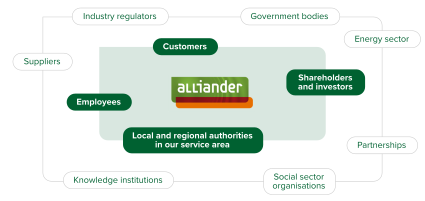
We engage with the following and other stakeholder groups on a regular basis to discuss the major grid congestion and energy transition challenges:
Customers: households and businesses.
Partners in the implementation chain: suppliers of materials, services and technology, permitting authorities and financiers.
Public authorities, policymakers and other parties with a major role in the energy system overhaul: supervisory authorities, municipal authorities, regional authorities, other network operators, government ministries in charge of policy in our domain and civil society organisations.
Customers
We not only engage with our customers to get a proper understanding of their questions and future energy needs that guide their choices, but we also aim to actively involve customers in energy issues and align their energy-related behaviour with congestion management services and other aspects. We do this in various ways, including by conducting targeted customer surveys, having relationship or account managers reach out to customers, sending out questionnaires and running pilots. Besides our customer services department and website, we use social media for customer contact. These channels are used to respond to individual queries and post updates on works in people’s local area. Alliander has made improving communication with customers and stakeholders one of its priorities. We continuously monitor how often our communication channels are used and what customers think about them. Where appropriate, customers can share negative experiences through the Complaints Procedure.
Partners in the implementation chain
With our suppliers, contractors and other parties, we maintain close and long-term relationships that are necessary to scale up quickly and effectively, as well as to get more work done. To this end, we have an organisational unit called ‘Major Work Packages’ that helps these partnerships scale up further. In June 2024, we sealed an implementation agreement with other regional network operators, public authorities and partners. This implementation agreement contains arrangements with respect to working together to accelerate implementation and the energy transition. Having sufficient work supervision capacity available is essential in this regard. Our aim is to ensure we have sufficient qualified workers available to be able to carry out the four national work packages from the implementation agreement: the local low-voltage grid approach, building charging infrastructure, the large-scale medium-voltage grid upgrade and the customer self-connection service.
Other partners
We are in consultation with the Dutch Ministry of Climate Policy and Green Growth and the Ministry of Housing and Spatial Planning to ensure effective policies for topics like the decarbonisation of the energy system and solving grid congestion. These consultations are part of programmes such as the National Network Congestion Action Programme, the National Energy System Plan and the National Programme on Sustainable Industry. We work with municipal and provincial authorities on the issue of spatial integration of infrastructure. Through integrated programming, we also work together on developing the future energy system. Energy Boards have been set up in each of the provinces for administrative collaboration in this area, aimed at acceleration and making choices. We involve civil society organisations and organisations representing specific stakeholders so that we can take their views and insights into account. We seek their input for our investment plans, for example, both when defining the starting points for the scenarios and later in the process when we submit the draft investment plan for consultation. Together with other network operators, we are working on the scenarios that Netbeheer Nederland, the association of power and gas grid operators, uses in developing the energy system of the future. These scenarios were published in May 2025.
How we harness stakeholder insights
We use our stakeholders’ insights to fine-tune our strategy. For our stakeholders, network congestion is the single biggest problem they face in the short term. As we do not always have a cut-and-dried solution to that problem yet, we continue our search for unconventional solutions to rise to the challenges, so that we can ultimately meet the needs of our customers and society.
Preventing stakeholder bias
Stakeholder bias is something that can manifest itself in all kinds of different ways. When estimating and determining materiality, we continuously analyse which stakeholders are affected by our impact or affect our decisions. Bias is something we want to prevent as much as possible by inviting multiple stakeholders and stakeholder groups to observe what we do. We have internal and external talks on topics, seeking input from various sections of the organisation and from external stakeholders. This is monitored by the annual report steering group and reviewed separately by the Management Board. We ask our youth panel called the Future Leader Board to co-read and review our annual report, and we organise a stakeholder panel every year to go over the annual report. This process reveals a wide range of insights, perspectives and interests. The input provided informs our decisions.
Ensuring stakeholder engagement
In making policies and setting objectives, we weigh the interests of key stakeholders. Policies are posted on the intranet, our website or, where applicable, divulged through other appropriate channels. The Management Board has delegated responsibility for incorporating our stakeholders’ views on our strategy and business model to several business units/departments within the organisation:
Corporate & Social Affairs (CSA) is responsible for engaging our social stakeholders.
Customer & Design is responsible for customer relationships with respect to future transmission needs and for acquiring land for new substations.
Strategic Resource Management is responsible for supplier relationships.
Asset & Product Management is responsible for gauging stakeholders’ views as part of the process of preparing our investment plan.
Private Customers and Market Services are responsible for contact with consumers and large business customers.
High-Volume Connections, Reconstructions & Grids is responsible for large business customers in the context of setting up new high-volume connections.
Major Work Packages is responsible for organising large-scale projects we are taking on as part of long-term and meaningful partnerships with implementation partners and public authorities.
Stakeholder table
|
Stakeholder |
Items for discussion |
Type of interaction |
Topics discussed |
|---|---|---|---|
|
Customers (consumers) |
Collaboration, relationship management, dialogue, service improvements |
Digital panel |
Climate change (E1 ), Consumers and end-users (S4) |
|
Quantitative research |
|||
|
Complaints and mediation (per case) |
|||
|
Qualitative research (various) |
|||
|
Dialogue |
|||
|
Customers (business) |
Collaboration, dialogue, service improvements |
Dialogue and relationship management (e.g. VEMW, Uneto VNI, Bouwend Nederland, VNO NCW) |
Climate change (E1 ), Consumers and end-users (S4) |
|
Employees |
Participation, dialogue, employee engagement and initiatives, formal negotiations (on pay and employment conditions) |
Formal consultation meeting |
Own workforce (S1), Consumers and end-users (S4) |
|
Dialogue, workshops, meetings |
|||
|
Employee association |
|||
|
Employee volunteering |
|||
|
Periodic negotiations on pay and employment conditions |
|||
|
Shareholders |
Formal/informal consultations, knowledge and insight into activities |
General Meeting of Shareholders |
All topics |
|
Meeting of Major Shareholders |
|||
|
Consultative meetings, individual contact |
|||
|
Biennial reputation survey |
|||
|
Investors |
Relationship management, explanation and disclosure |
Bi-yearly in-person non-deal roadshow, online deal roadshows |
All topics |
|
Annual and half-yearly reporting and disclosure |
|||
|
Local and regional authorities |
Coordination of climate and energy plans and projects, investment areas |
Consultation, collaboration, projects |
Climate change (E1), Consumers and end-users (S4), Business conduct (G1) |
|
Government bodies |
Expression of interest and active/proactive dialogue |
Consultation, having a say, views |
Climate change (E1), Consumers and end-users (S4), Business conduct (G1) |
|
Politicians |
Keeping them informed generally and on specific topical subjects |
Relationship management, working visits, proactive and reactive updates |
Climate change (E1), Consumers and end-users (S4). Business conduct (G1) |
|
Qualitative research |
|||
|
Industry regulators |
Informing, sharing knowledge, providing explanations and disclosure |
Regular meetings on topical subjects and issues, standard and ad hoc information requests |
Own workforce (S1), Workers in the value chain (S2), Consumers and end-users (S4), Business conduct (G1) |
|
Energy sector |
Knowledge sharing, partnerships, promotion of interests, collaboration |
Participation in boards |
All topics |
|
Working groups |
|||
|
Suppliers |
Collaboration, relationship management, dialogue |
Contracting Day |
Climate change (E1), Circular economy (E5), Workers in the value chain (S2) |
|
Supplier Days |
|||
|
Topic consultations |
|||
|
Responsible procurement consultations |
|||
|
Knowledge institutions |
Knowledge sharing and partnerships |
Collaboration, knowledge development, co-creation, knowledge sharing |
Own workforce (S1) |
|
Media |
Informing, positioning |
Relationship management, proactive information, crisis communications, qualitative research |
All topics |
|
Social sector organisations |
Volunteering |
Employee volunteering |
Own workforce (S1) |
|
Participation, dialogue and relationship management |
Alignment, participation in associations and foundations |
Climate change (E1), Own workforce (S1), Consumers and end-users (S4) |
|
|
Partnerships |
Collaboration with knowledge institutions, the business community and government bodies, promoting sustainability, new models for innovation and social development, facilitating a sustainable energy supply |
Participation in boards, meetings, sponsoring, strategic collaboration, consultation and dialogue |
Climate change (E1), Circular economy (E5), Workers in the value chain (S2), Consumers and end-users (S4), Business conduct (G1) |
|
Corporate partnerships |
Collaboration with the business community and government bodies, promoting sustainability, new models for innovation and social development, sustainable energy supply |
Meetings, collaboration, development, consultation and dialogue, commissioning projects, strategic partnerships |
Climate change (E1), Circular economy (E5), Workers in the value chain (S2), Consumers and end-users (S4), Business conduct (G1) |
Material impacts, risks and opportunities and their interaction with the strategy and the business model
Based on the double materiality assessment (DMA) we conducted, we have defined six ESRS topics as material topics. The ‘Information on sustainability topics’ paragraph will explain how these interact with our strategy and our business model.
Alliander has a solid financial position, and therefore also has a resilient business model and resilient strategy in order to address material risks and impacts. Current financial impacts are recognised in the financial statements. For more background information, please see the financial statements. We have not performed any further IRO-specific qualitative or quantitative assessments based on this. Targeted financial effects are included in our business plans. Scenario analyses are part of our business plan process.