Corporate governance
As a major energy network company, we have a significant social task to fulfil in Dutch society. In this role, we feel responsible for transparent business operations and rules for good governance, effective supervision and adequate accountability to our stakeholders.
Alliander Group
The Alliander Group includes Alliander N.V. (Alliander) and subsidiaries Liander N.V., Qirion B.V., Alliander Telecom N.V., TReNT Infrastructuur B.V., QTERRA B.V. and Firan B.V. Alliander heads up the group structure and applies the full two-tier governance model. Alliander has a two-tier management structure, with a Management Board and a Supervisory Board. The Management Board and Supervisory Board are accountable for the performance of their duties to the General Meeting of Shareholders (AGM). The Management Board is supported by the Executive Committee. All of Alliander’s shares are held by Dutch provincial and municipal authorities.
Governance framework
Alliander’s governance structure is based on Book 2 of the Dutch Civil Code and the Dutch Corporate Governance Code. The Dutch Gas Act and the Dutch Electricity Act 1998 also influence the governance of Alliander. The structure is set out in articles of association, various internal regulations and other documentation on corporate governance (new window).
The shares in Alliander are not listed on the stock exchange. Alliander voluntarily applies the principles of the Dutch Corporate Governance Code (the Code), which was updated in March 2025. The Code is applied at the level of Alliander N.V. as a holding company. See our corporate website for full details of our compliance with the Code in the 2025 financial year based on the principle of ‘apply or explain’. The updated Code applies from the 2025 reporting year. Where necessary, internal regulations and other internal rules and procedures have been amended to comply with the updated Code.
In addition, Alliander endorses the VNO-NCW Tax Governance Code and we publish an annual transparency report on the tax policy pursued in line with this code.
Governance roles
Management Board and Executive Committee
The Management Board is responsible for managing Alliander and is accountable for setting and achieving the objectives, strategy and policy, and the ensuing results. In addition, the Management Board ensures compliance with all relevant legislation and regulations, risk management and financing of the company. At the end of 2025, the Management Board consisted of two members: the CEO and the CFO. The members of the Management Board have agreed on an allocation of specific duties and responsibilities while maintaining the collective responsibility of the Management Board as a whole. The Supervisory Board has approved the split of tasks and responsibilities.
The Management Board is supported in the performance of its duties and responsibilities by the Executive Committee (ExCo). As of 17 April 2025, the ExCo consists of seven members. Of the members, the Chief Executive Officer and the Chief Financial Officer are company officers appointed under the articles of association. In addition, five members who are not company officers appointed under the articles of association sit on the ExCo: the COO Networks, the COO Customers, the CTO, the CHRO and the CDO. This leadership structure ensures direct and integrated control of Alliander Group's key operational responsibilities, such as scaling up production, increasing customer value and developing a future-proof and integrated energy system. The broad composition of the ExCo strengthens business operations and promotes the implementation of the strategy. The ExCo jointly manages Alliander on a day-to-day basis. The Management Board has ultimate responsibility for the actions and decisions of the ExCo. The CEO is the ExCo chair and the primary point of contact between the ExCo and the Supervisory Board and its chair. The Supervisory Board’s supervision only extends to the ExCo members who are company officers under the articles of association. The ExCo members who are not company officers under the articles of association only attend Supervisory Board meetings if there are items on the agenda that pertain to their specific portfolio.
The Supervisory Board appoints the members of the Management Board. Members of the Management Board are appointed for an indefinite period of time. The Supervisory Board also has the power to suspend or dismiss members of the Management Board. The Management Board appoints, suspends and dismisses the other members of the ExCo.
Supervisory Board
The Supervisory Board supervises the policy of the Management Board and the general course of affairs within Alliander. The Supervisory Board also advises the Management Board. In addition, the Supervisory Board is the employer of the Management Board. Alliander’s Supervisory Board has also been designated as the supervisory body for Liander N.V., the network operator within the Alliander group. The Supervisory Board is fully responsible for the performance of its duties.
New members of the Supervisory Board are nominated by the Supervisory Board and appointed by the General Meeting of Shareholders, taking into account the job profile and the diversity policy. Supervisory Board members are appointed in accordance with the Code, in the sense that a term of appointment of two four-year periods applies as a starting point, and any subsequent appointment is justified in the Supervisory Board's report. At year-end 2025, the Supervisory Board had six members. The members of the Supervisory Board step down in accordance with the retirement schedule established by the Supervisory Board.
The Supervisory Board has set up two permanent committees from among its members, an Audit Committee and a combined Selection, Appointment and Remuneration Committee. These committees prepare the materials required for decision-making in the Supervisory Board meetings. The Supervisory Board remains collectively responsible for the decisions prepared by a committee.
Shareholders
The shares in Alliander are held by four Dutch provincial authorities and 70 municipalities. A full list of the shareholders can be found on our corporate website.
The AGM is the body in which the shareholders exercise their rights to control Alliander. This annual meeting is held within six months of the end of the financial year, in the presence of the members of the Management Board and the Supervisory Board. In this meeting, the shareholders discuss the annual report, adopt the financial statements and dividend, and grant discharge from liability to the members of the Management Board for the policy implemented and to the members of the Supervisory Board for the supervision exercised. In the intervening period, the Management Board, the Supervisory Board and the shareholders may convene general meetings as often as desired.
Certain powers of the AGM have been assigned to the Committee of Shareholders. These include powers regarding recommendation, appointment and dismissal of Supervisory Board members and regarding appointment and dismissal of Management Board members. Furthermore, there are regular informal consultations between the Management Board and representatives of the major shareholders through the Sounding Board Group (official forum) and the Meeting of Major Shareholders (administrative forum).
Internal audit function
Within Alliander, the Internal Audit department performs the internal audit function. Internal Audit provides the Management Board and management of Alliander with independent and objective insight, advice and (additional) assurance regarding the effectiveness of the risk management, control and governance processes.
Internal Audit falls under the responsibility of the Chief Executive Officer and has direct contact with the Audit Committee and the external auditor. The Internal Audit manager normally attends Audit Committee meetings. The Audit Committee supervises the internal audit function and advises the Supervisory Board on the role and performance thereof. The Management Board annually assesses the way in which the internal audit function carries out its task, after consultation with the Audit Committee.
Each year, Internal Audit draws up a risk-based audit plan after consultations with the Management Board, the Audit Committee and the external auditor. The audit plan is submitted to the Management Board for approval and then to the Supervisory Board. The Audit Committee discusses the progress of the plan, the main findings and follow-up in respect of the recommendations at its meetings. The external auditor also receives this information.
External auditor
The AGM appoints the external auditor, as proposed by the Supervisory Board. PricewaterhouseCoopers Accountants N.V. has acted as Alliander's external auditor from the 2024 financial year onwards.
The Audit Committee oversees the relationship with the external auditor. In principle, the external auditor attends all meetings of the Audit Committee. The external auditor also attends the meeting of the Supervisory Board in which the external auditor’s report on the audit of the financial statements and review of the sustainability statement are discussed. The external auditor also attends the Supervisory Board meeting where the half-year figures will be discussed. Additionally, the external auditor attends the meeting of shareholders to answer any questions the shareholders may have regarding their audit activities and opinion on the financial statements and the sustainability statement.
Risk Management & Compliance
Risk Management & Compliance (RM&C) supports the Management Board and management in achieving the business objectives by providing insight into risks and compliance issues in relation to Alliander’s strategy and activities, and by advising on (control) measures to be taken. The RM&C manager reports to the Corporate Control director. RM&C submits a risk report to the Management Board and Audit Committee every six months. The Corporate Control director attends all Audit Committee meetings as standard.
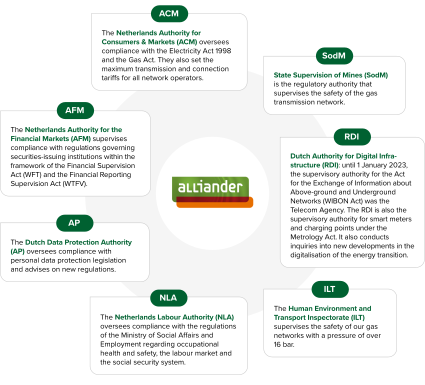
Industry regulators
External organisations supervise Liander N.V. in its capacity as a network operator active in a regulated environment. They supervise such aspects as compliance with specific legislation and regulations. The main industry regulators: