Basic principles for the sustainability statement
Basis
General
The sustainability statement relates to the 2025 reporting year. The report has been prepared in accordance with the requirements of the European Sustainability Reporting Standards (ESRS) and Article 8 of Regulation (EU) 2020/852 (the Taxonomy Regulation), including the application of applicable quick-fix amendments approved by the EU in 2025.
Consolidation
In principle, the sustainability statement uses the same consolidation structure as Alliander’s financial statements. Any deviations in scope arise from the results of the double materiality assessment. The double materiality assessment is intended to determine which impacts, risks and opportunities are material and may therefore focus on specific parts of the organisation or value chain. Any deviations from this structure in the report are explicitly stated. Alliander does not have any subsidiaries that are exempted from the obligation to report on their sustainability performance under Directive 2013/34/EU. There are no specific circumstances impacting preparation of the sustainability statement, nor has there been any deviation from the medium or long-term horizon. The standard time horizon we use in the sustainability statement is the same as the financial time horizon (short < 1 year, medium 1-5 years, long > 5 years).
Alliander's operating income totalled €3.4 billion in 2025 (2024: €3.9 billion). Pursuant to IFRS 8, Alliander distinguishes two segments: network operator Liander and Other. Total operating revenue, including internal revenue and excluding exceptional items, came in at €3.1 billion (2024: €2.9 billion) at the Liander segment and at €0.8 billion (2024: €0.7 billion) at the Other segment. Operating income from gas totalled €0.6 billion (2024: €0.6 billion). See note 2 ‘Segment information’ to the financial statements.
Value chain
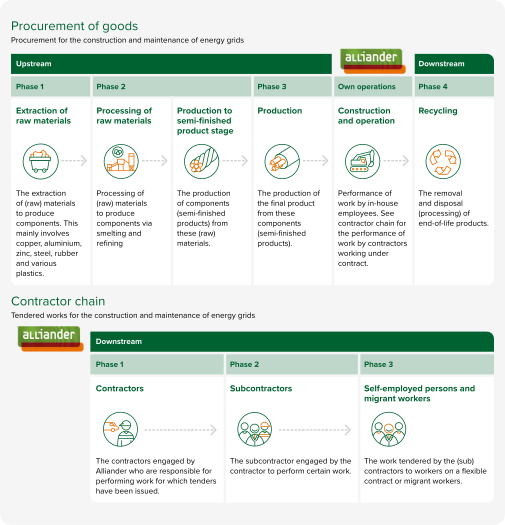
For the purposes of this sustainability statement, the value chain is made up of Alliander’s own operations and two further links, with Alliander and its direct and indirect suppliers on the upstream side and end-users and contractors on the downstream side, which also includes contractor staff as workers in the value chain. We purchase products from suppliers and hire contractors as part of our obligation to maintain the grid. Alliander’s role in the energy value chain is detailed in the 'Profile of Alliander' section of this annual report.
Alliander’s value chain
Estimates and assumptions
In preparing the sustainability statement, we use estimates and assumptions regarding our own operations and those across our value chain. This applies in particular to the indicators for Climate change (E1) (including Scope 3 GHG emissions) and Circular economy (E5). When we use estimates and assumptions to determine the value of indicators, we include explanatory notes with references to source documentation, details of the degree of accuracy and the methodology used.
We review our estimates and assumptions periodically and adjust them as necessary. We account for any changes resulting from such reviews in the period when the changes occurred.
Inclusion by reference
Certain disclosure requirements in scope for this sustainability statement are included by reference in other sections of this annual report. This information falls under the limited assurance procedures for the sustainability statement. Whenever we include information by reference, this is clearly indicated in the relevant section. The following information is included by reference to other sections of the annual report:
|
Reporting requirement |
Description |
Location in this annual report |
|
ESRS 2, Article 21c |
Composition and diversity of members of administrative, management and supervisory bodies with regard to relevant experience in sectors, products and geographical locations |
Corporate Governance section, Governance roles, Management Board and Executive Committee subsection |
|
Personal Details section, Management Board subsection |
||
|
Corporate Governance section, Governance roles, Supervisory Board subsection |
||
|
Personal Details section, Supervisory Board subsection |
||
|
ESRS 2, Article 40b |
A breakdown of total revenue, as included in the financial statements, by significant ESRS sectors, reconciled with IFRS 8 information |
Financial statements, note 2 |
|
ESRS E1, Article 55 |
Reconciliation between the line item in the financial statements and the net revenue amounts used in the calculation of the GHG emissions intensity |
Financial statements, note 21 |
|
Information on assumptions and estimates made in relation to network losses |
Financial statements, note 35 |
|
|
EU taxonomy |
Financial statements, notes 3, 4 and 21 |
|
|
ESRS S1, Article 50f |
Cross-reference to the total number of employees in service (in FTEs) |
Financial statements, note 24 |
The ESRS reference table also specifies which disclosure requirements are included by reference.
Comparative figures
Where possible, we included comparative figures in this sustainability statement. Where comparative figures for certain indicators were not yet available, we indicated this and provided a separate explanation.
In accordance with ESRS 2 Article 13, comparative figures were adjusted to improve consistency and comparability with the 2025 reporting year. Adjustments were made on account of calculation methods and data availability. The majority of the adjustments resulted from recalculations. In addition, a single error from 2024 has been corrected. Adjustments to comparative figures are explained for each indicator, including the nature of the adjustments. While the adjustments did not lead to new insights regarding the nature of impacts, risks or opportunities, they do ensure better alignment with the method used for the current reporting year.
Other
The external auditor has performed a limited assurance review of the sustainability statement. No other external bodies validate one or more of the sustainability indicators other than the following. Kiwa conducted an audit under the CO₂ Performance Ladder and certified our cable suppliers’ raw material passports, while SBTi (Science Based Targets initiative) assessed our climate targets. Besides these specific processes, sustainability indicators were not externally validated.
Alliander kept the structure and layout of the sustainability statement for 2025 as closely aligned as possible with that of the 2024 edition. For the sustainability statement for 2026, the structure and layout will be reassessed on the basis of the final version of the new ESRS standards and adjusted where necessary.